California’s Citrus Heritage
By Mary Alice Cline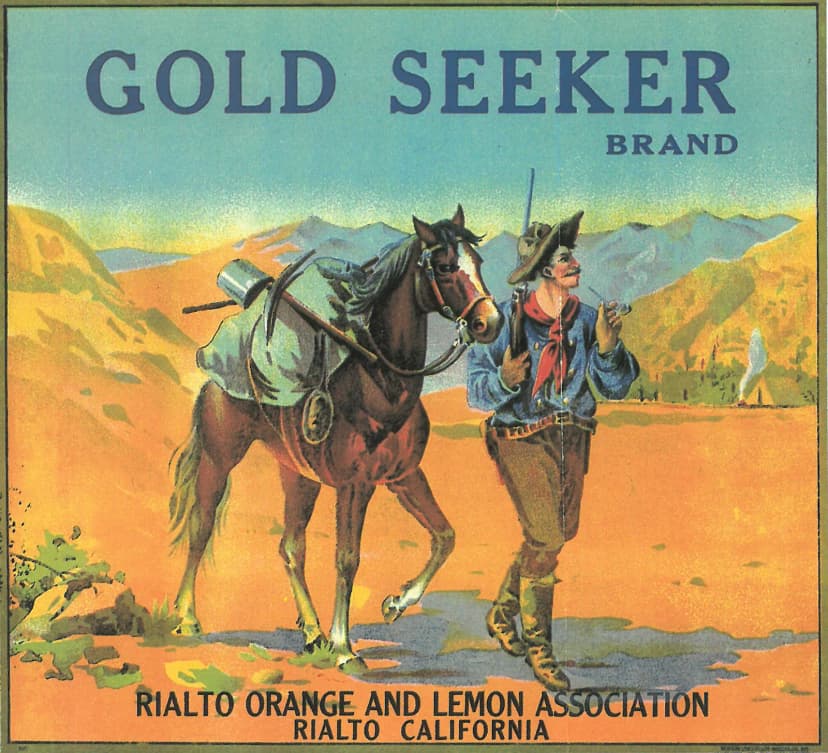 Figure 1
The planting of citrus trees in Southern California played a role in the development of the Golden State as important as the 1848 discovery of gold at Sutter's Mill. Both triggered a massive migration to the west: the rush of the forty-niners to the goldseam in the North (fig. 1) and the gradual influx of settlers into the future citrus groves of Southern California. Eastern Americans headed for California in part because of the romantic depictions of a coastal paradise seen on the labels which were used to promote the sale of citrus fruit. Such pictures caused the association of California with sunshine and an easier manner of living which became deeply ingrained in the popular imagination — the image, accurate or not, of the California lifestyle as it is perceived today.
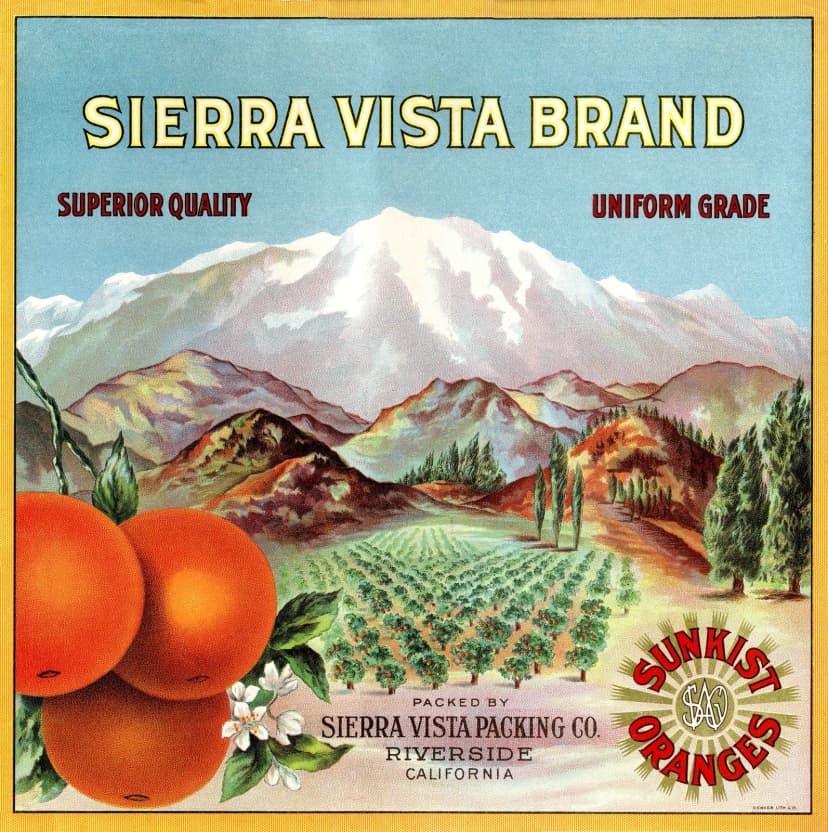
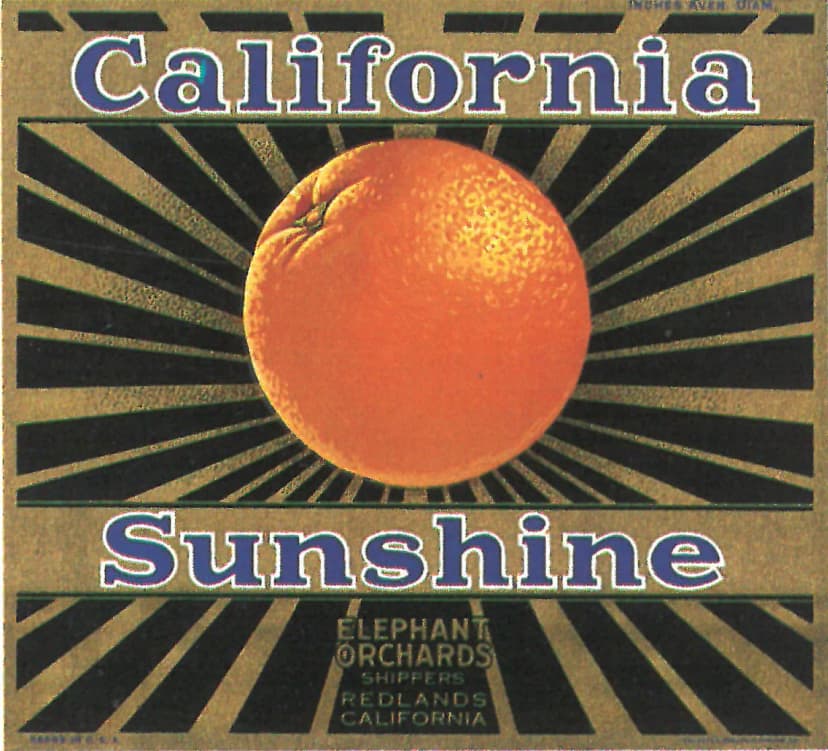 Figure 2
Unlike mining, which commenced in the 1840s and lasted for little more than 50 years, the growth and marketing of citrus began earlier and has continued as a major industry throughout the 20th century. Goldmines are abandoned today, or exist only as tourist attractions. But citrus groves and their popular products remain — a thriving part of the American Southwest's enormous agricultural industry and a source of continual pleasure to tourists (fig. 2). The citrus belt of the west, extending from near the Arizona-Mexico border into the vast Central Valley of California, has social and economic repercussions which transcend state boundaries. Some 300,000 acres of citrus groves, and the packing and sale of their product, contribute immeasurably to the economy of the entire Southwest as well as of the nation as a whole. The growth of citrus fruit in California, both literally and as an industry, has been and remains a historical success story. How did it come about?
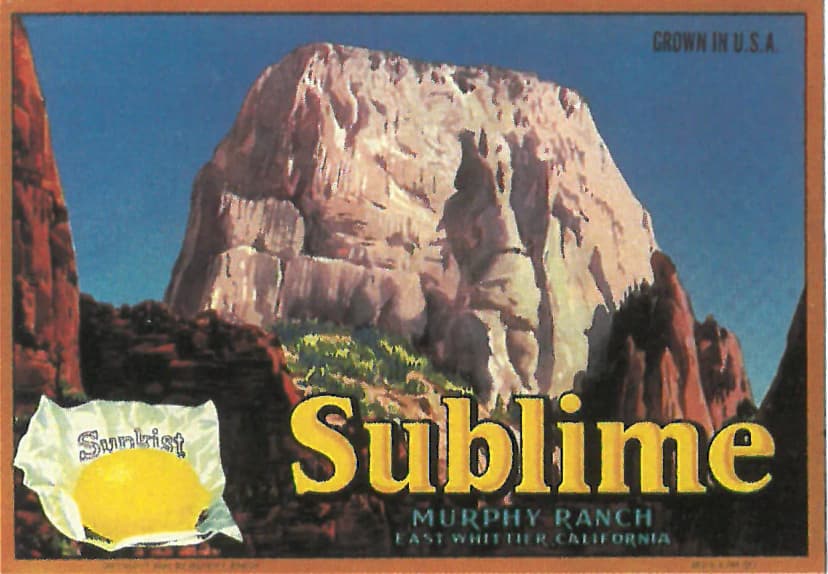
What better way to recount the history of citrus in the west than with the lively colors and fascinating subject matter of citrus crate labels as a part of the story? Nearly every aspect of California's natural terrain (fig. 3) and lifestyle appeared on the thousands of paper crate labels printed between the 1880's and 1950's. Telling the story of citrus fruit without a fair sampling of this colorful genre of commercial art would be akin to listening to the lyrics without the music. Labels better than words show how Californians discovered the natural gold of fruit even as the Mother Lode was uncovered. Our story should start, however, in ancient times. It all began with the orange.
From The Old World To The New
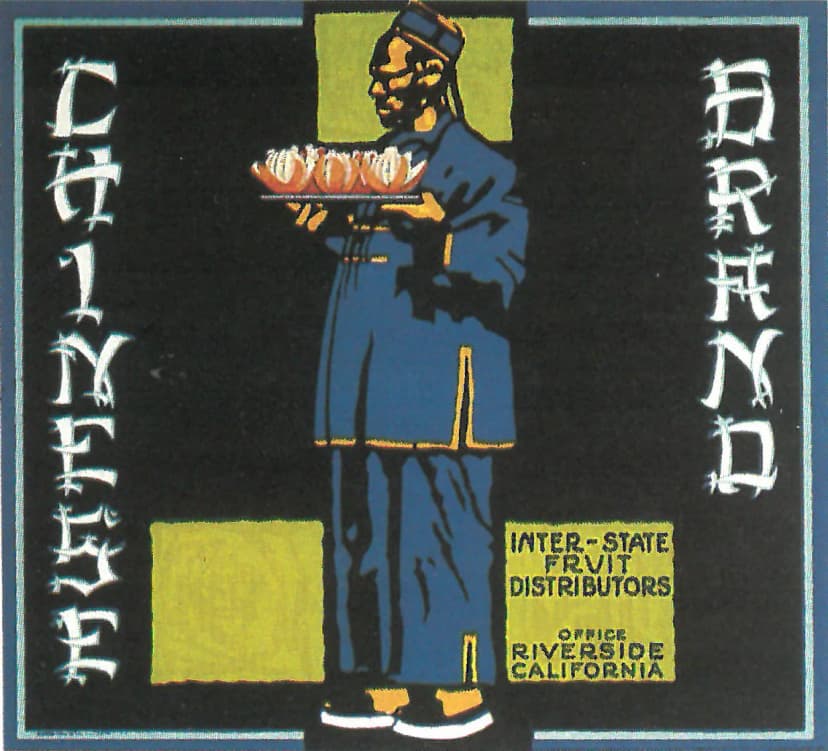
It is thought the world's first orange appeared on the southern slopes of the Himalayas in northeast India and Burma. Early forms of the orange moved by trade caravans through the mountain passes into western and southwestern China (fig. 4), and to the Indochinese peninsula. The sweet orange, as we know it today, developed in southern China; perhaps the earliest-known reference to it was in a work by Yu Kung about 2000 B.C.
The ancient Chinese were intrigued by the orange's vivid color, often likened to precious gold or the life-giving sun. In China, and later Japan, oranges were symbols of good luck and immortality. Detailed reference to 27 varieties of citrus ("Chulu" in Chinese) appeared in a learned treatise on the care and cultivation of citrus trees and a summary of Chulu's medicinal and aesthetic properties written in 1178 A.D. The name "Mandarin Orange" came, as did that variety of tangerine, from China's milleniums of citriculture.
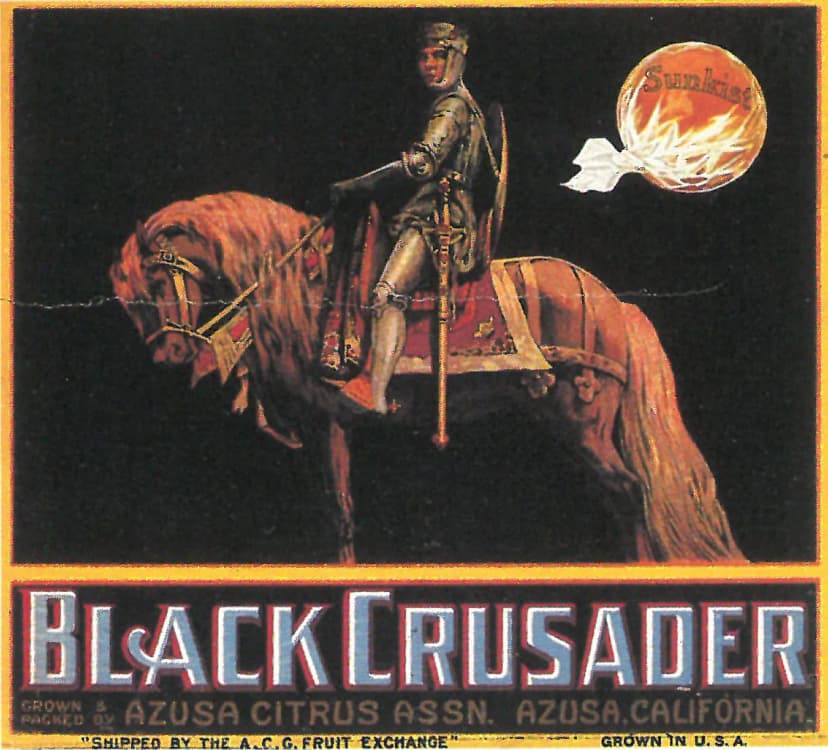
Though India enjoyed the orange from the dawn of history, lemons were unknown there until much later; for centuries citrus fruit was grown only as a delicacy to be served in the palaces of Nabobs and Rajahs. The citron (sour orange) was under cultivation in Persia by the time of Alexander the Great, and was known to the early Greeks and Hebrews. In the Roman Empire such scribes as Virgil and Pliny wrote of oranges with reverence and respect. With the expansion of Mohammedism by the Arabs (fig. 5) and Moors (500–900 A.D.), citrus moved into north Africa and crossed the Mediterranean to Spain. Oranges and lemons were abundantly cultivated in all of the eastern Mediterranean countries by the 12th century, the time when returning Crusaders carried the fruit back to western Europe (fig. 6) to grow it successfully in Italy and southeast France. Italian artists used oranges to symbolize the Holy Land, with Renaissance renditions of the Madonna and Child often set in an orange grove or embellished with garlands of orange blossoms. Today the orange blossom still carries a similar symbolic value — an association with good luck or immortality — as any bride can attest.
 Figure 5
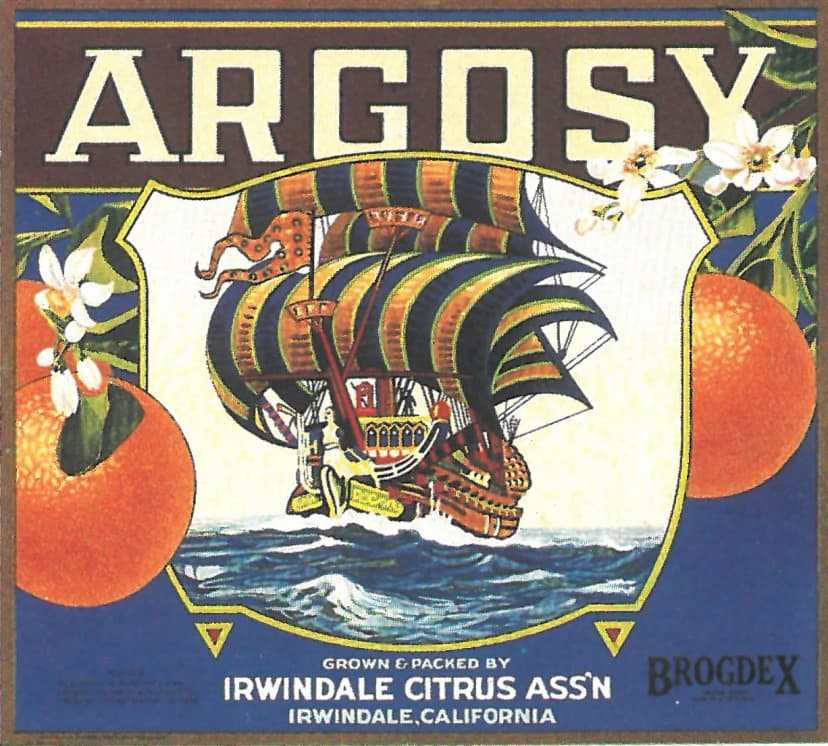
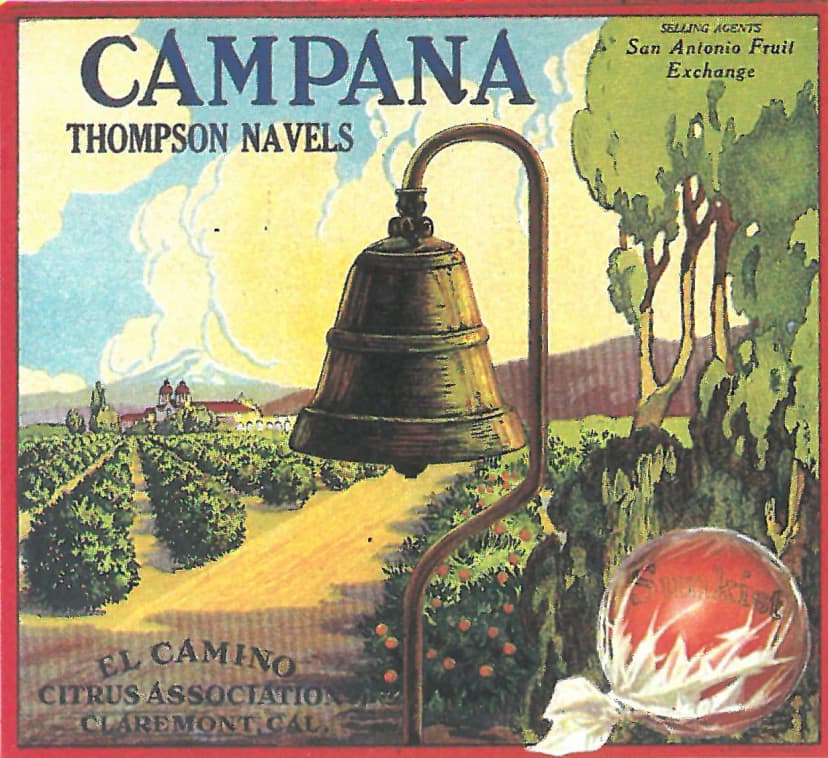
Of more direct importance to the citrus industry of the southwestern United States, however, was the Spaniard's penchant for oranges, his ability to grow them, and the similarity of southern Spain to the American Southwest in climate and soil. The fruit was served at the 15th-century court of Ferdinand and Isabella, and their favorite explorer-navigator carried citrus trees with him on his second voyage (fig. 7) to the New World in 1493. After Columbus, orange trees thrived on many islands in the Caribbean; from there they traveled to Mexico and Central America. The Portuguese, meanwhile, planted oranges and lemons as they colonized Brazil. But it was the Spanish missionary priests from New Mexico, moving northward, who colonized the parts of New Spain now known as Arizona and California. Carrying seeds or seedling trees from Mexico, the padres made sure that each new Mission (fig. 8) numbered citrus trees among its others. Arizona can claim the first citriculture of the Southwest for the southern part of that state by 1707 or earlier. The first oranges planted in California were probably at the Mission of San Diego founded by Father Junipero Serra in 1769. From there, orange and lemon trees moved northward to grow in many coastal regions wherever the California Missions were established. These trees were planted, as were such other Spanish staples as figs, olives and grapes, solely for the use of those living and working at the settlements. Their fruit was not intended for sale or trade. The cultivation of citrus as a commercial crop would not occur in the Golden State until well into the 19th century.
The Incubation of an Industry
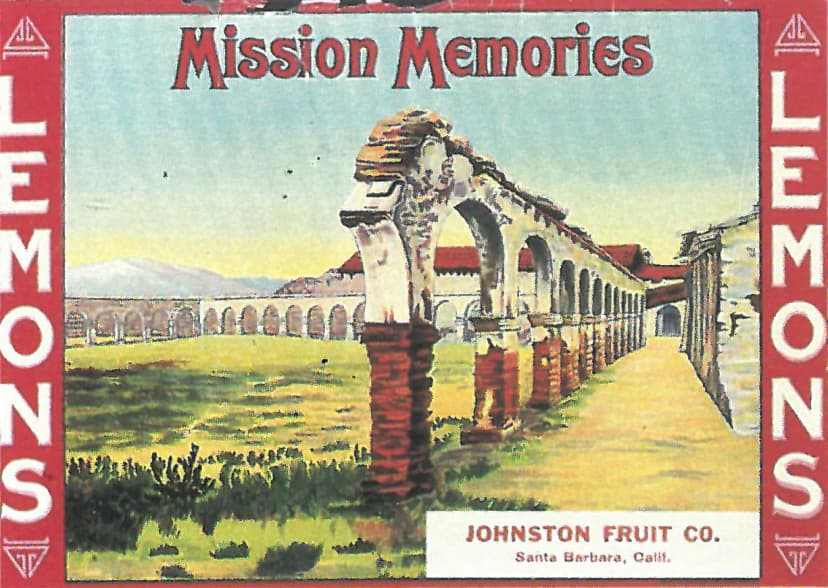
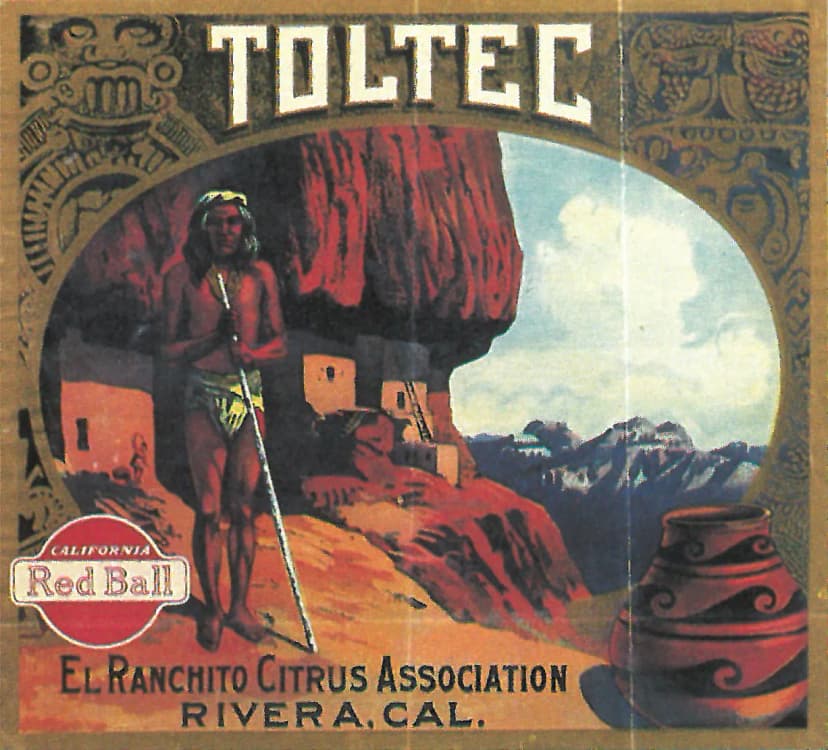
The first California orange orchard of any size was planted at San Gabriel Mission in 1803 (fig. 9) and consisted of 35 trees of seedy, sweet oranges. By this time the chain of Missions, stretching some 700 miles northward from San Diego, had demonstrated that citriculture could be successful along a strip bordering the Pacific coast. By the mid-1850s, after California had joined the United States and the Santa Fe Trail had been blazed, large numbers of Americans made the long trek to the West coast (fig. 10).
In 1834 one Louis Vignes planted what was probably California's first commercial citrus grove near a sleepy little pueblo called Los Angeles. A much larger stand of trees was set out in 1841 by William Wolfskill, who began with two acres of young seedlings acquired from the San Gabriel Mission (fig. 11). He soon cultivated some 26 acres, eventually expanded to 70 acres of oranges and lemons on his ranch in the middle of what is now downtown Los Angeles. His timing was fortuitous, for the Gold Rush of '49 brought a demand for lemon or lime juice to prevent winter attacks of scurvy in the cold, overcrowded and under-provisioned mining country. Wolfskill's oranges and lemons went by ship from Los Angeles to San Francisco harbor, from there by riverboat and buckboard to the mining camps. Lemons were sold for as high as $1.00 a piece in the Mother Lode country at the height of the gold market, and supplying this booming market made Wolfskill a wealthy man. His financial success did not go unremarked by farmers in other California communities. Citrus cultivation began in the Riverside-San Bernardino area about 1857. The 1860s saw orange trees planted in Tulare county in the state's Central Valley, and by 1871 citrus trees were even being set out north of San Francisco in Butte and Sonoma counties.
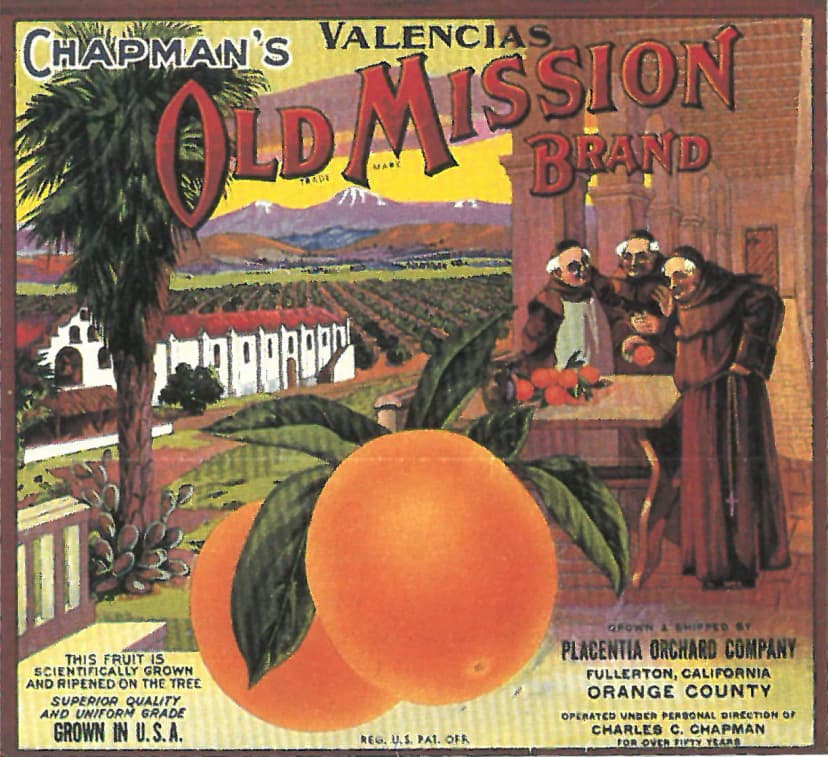
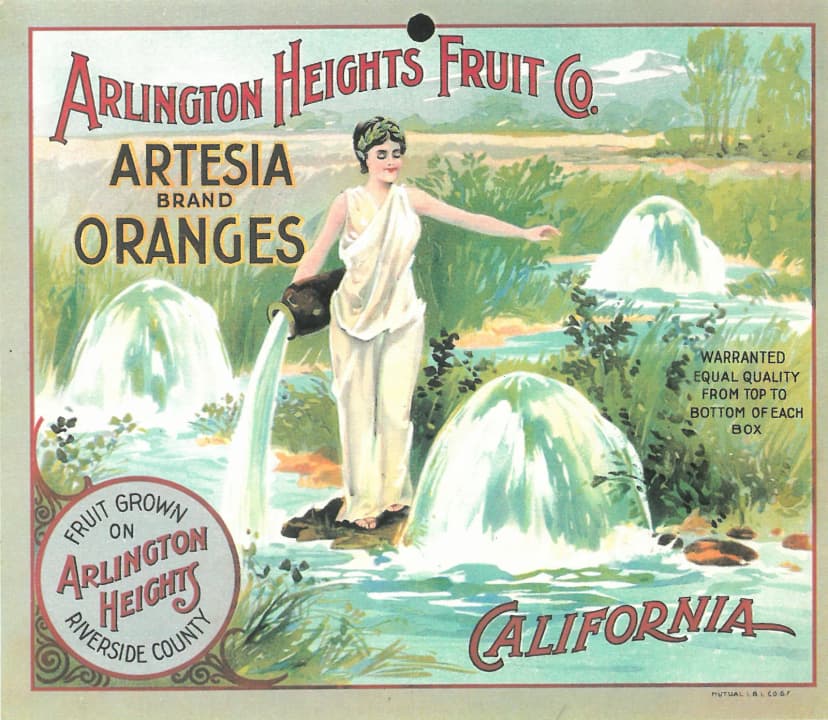
Many developments important to the evolution of the citrus industry in California centered in and about Riverside. What happened in this small community some sixty miles inland from Los Angeles was not unlike what was happening in most of the other citrus growing areas.
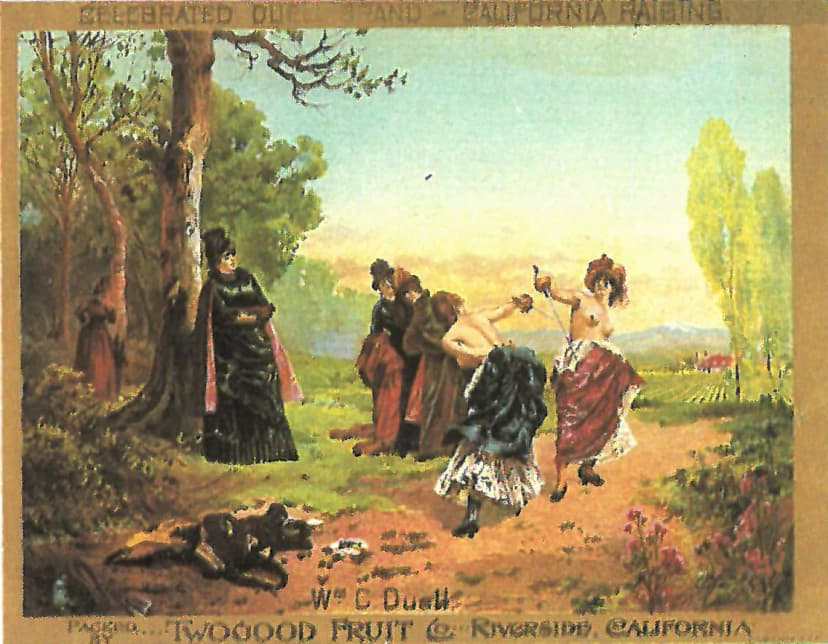
In and near Riverside, water companies began digging canals from nearby rivers and tapping the abundant Artesian water beneath the Riverside-San Bernardino basin (fig. 12). At the same time, shortly after the Civil War, land development and land sales began in earnest. Such companies as the Southern California Colony Association sold solid citizens of the East and Midwest numerous parcels of land, most of it in 2 or 10 acre plots. These buyers, who began to take possession of their acreages in 1870, became Riverside's first commercial growers. Such early residents had no intention of devoting most of their land to citrus. Vineyards were more prevalent, and Riverside's primary cash crop was originally raisins (fig. 13). Fruit from early Riverside vineyards and groves was either sold locally or hauled to Los Angeles for ocean shipment to San Francisco. Whatever was grown, required irrigation, protection from the winter frost common to the inland valleys, and constant vigilance against insects and disease. The first citrus growers' lives were not easy. Few in Riverside realized at the time that a local event of the 1870s was to become the single incident most important to the development of the citrus industry in California and, later, Arizona. An oft-told story, it has been described as everything from "a lucky accident" to "witchcraft in the Brazilian jungle". It began with the appearance of a "sport" (mutant fruit) on an orange tree of a Portuguese species called "Selecta" growing in Bahia, Brazil. Agent William Saunders of the U.S. Dept. of Agriculture heard about the discovery of this new strain of supposedly seedless orange, and managed to obtain a few viable seedlings for botanical experimentation in Washington, D.C. Most of these were kept for budding new stock, but two were sent to Luther and Eliza Tibbetts, newly arrived homesteaders in Riverside, in response to a request from Mrs. Tibbetts (fig. 14). The seedling trees arrived at the Tibbetts' home in late 1873, and were probably planted outdoors the following spring. There had been a debate for years as to just how many trees from Bahia were sent and to whom in which area. California historians Hall and Klotz have reprinted a pertinent letter in their book. Dated 1883 and originally published in the local newspaper, the letter is from Saunders to Mrs. Tibbetts and would appear to resolve conclusively any lingering question about the trees. In it the federal agent is discussing the new "navel species" as he states:
Young plants of that kind were not sent to Florida for several years after you received yours. You received two of the original plants as they came from Bahia and [no others] were sent out until we budded young stocks and sent them after two or three years old, and not a great many of them.
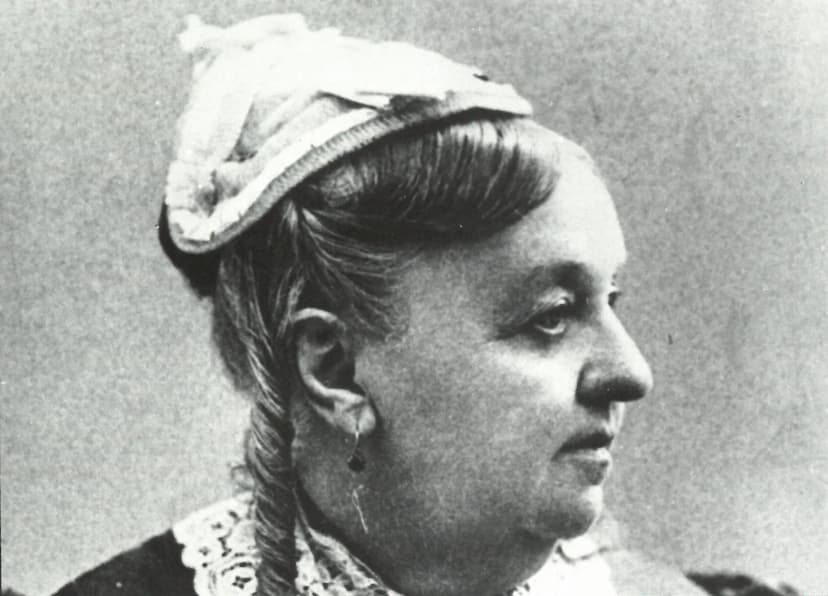 Figure 14
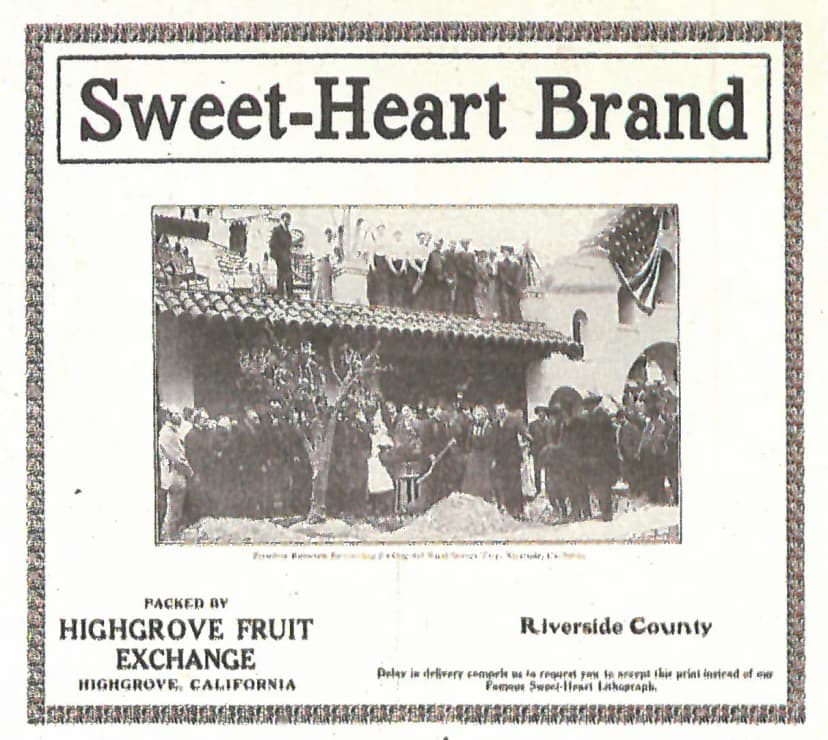
This much-heralded orange was (and is!) characterized by an excellent sweet flavor, an absence of seeds, and a round protuberance from which came its name, the Washington Navel. One of the Tibbetts' trees was transplanted to the courtyard of the Riverside Mission Inn in honor of President Theodore Roosevelt's visit in 1902 (fig. 15), and grew there until its demise in 1921. The other was fenced off and inscribed as a memorial to Eliza Tibbetts. This tree is alive and well today, and Riverside residents still reverently refer to it as "The Parent Navel."
Oranges had always been difficult to grow from seed. It often took nearly 20 years for an orange seedling to become a full and productive tree. Even the Mission Fathers had preferred the practice of "budding" trees to growing them from seed. This is done by cutting and binding the bud of a mature orange tree under the bark of a little seedling. The seedling tree (called the "rootstock") is generally a tough, easy-to-grow variety of orange. The transplanted bud then unites with its new rootstock and grows into a fully branched tree. With the advent of the seedless navel, the grafting of navel buds to roots taken from the hardy citron became standard practice. The time required to produce mature fruit by this method is normally about six years. The Tibbetts' were active in propagating the Brazilian species, and word of this exceptional new orange traveled like lightning when their first navels ripened in the late 1870s. By 1878 the Tibbetts' were irrigating 300 citrus trees and continuing to sell navel stock for as high as $5.00 per cutting; a plate of Washington navels exhibited at a citrus fair in 1879 won first prize (fig. 16). Transplanted from the humid, tropical climate of Bahia to the arid, irrigated lands and summer heat of inland California, the navel so thrived in its new surroundings that it developed a flavor and color far surpassing any fruit grown in the tropics. All that, and orange trees were beautiful to look at too.
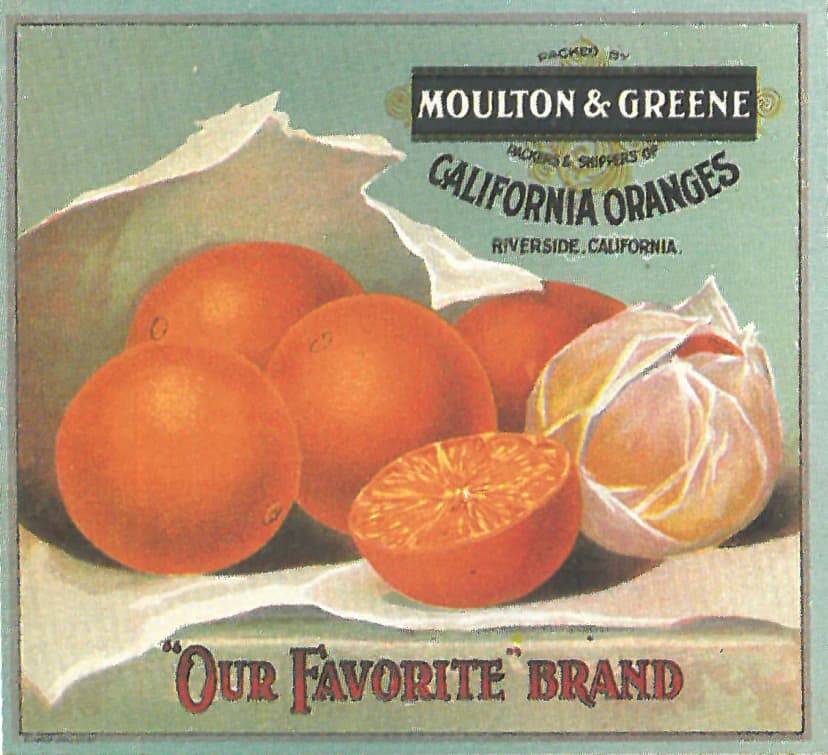
It was found that the navel ripened during the winter and spring months. Conveniently, the Spanish-derived Valencia orange, imported to California from England in 1876, was ready to pick in the summer and fall, a perfect companion to the navel. Surprisingly, both orange varieties could be left on the tree for several months after ripening without losing flavor or becoming overripe. Freshly-picked oranges could be packed and shipped virtually every day of the year!
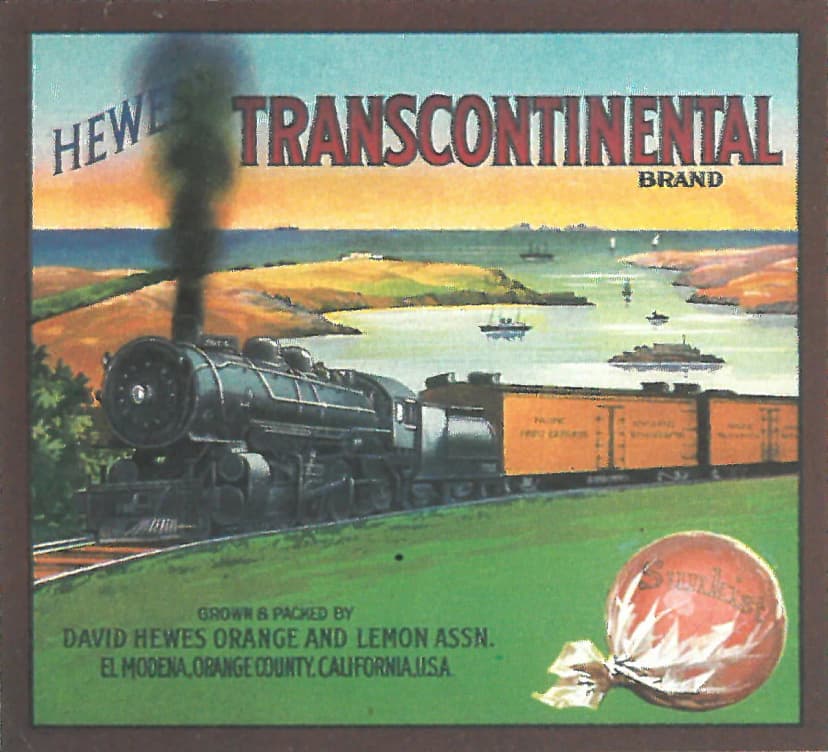
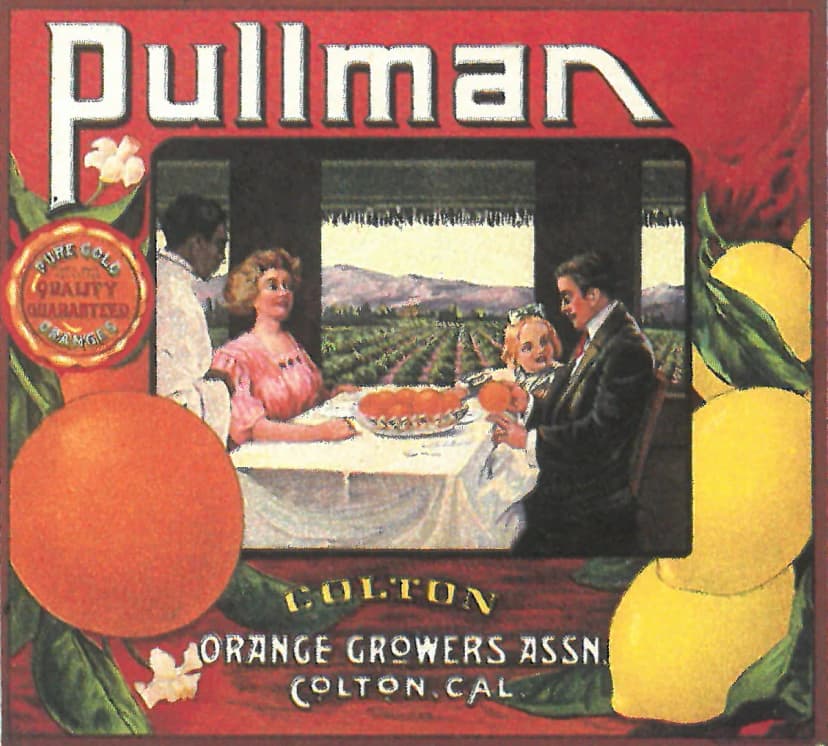
One more factor contributed significantly to the birth of citrus as a major industry. The construction of the Southern Pacific and Santa Fe railways in the 1870s and 1880s linked Southern California to the rest of the United States (fig. 17). This not only led to an influx of new settlers who heard tales of the agricultural promise of the state, but provided an eastern market for the fruit they would grow. The first eastbound shipment of fresh oranges was a carload sent from Los Angeles to St. Louis, Missouri, by William Wolfskill in 1877. It took a month to arrive at its destination, but the oranges were reported in edible condition and brought phenomenal prices.
Is it any wonder that most of the newcomers who settled the rural areas of California began to concentrate upon planting citrus trees?
Problems And Solutions — From Boom To Bust And Back Again
By 1883 there were enough citrus groves in the valleys of Southern California that the first historical book on San Bernardino county (which then contained what is now Riverside and much of modern Riverside county) devoted an entire section to Orange Orchards And Culture.
In this work the Riverside-San Bernardino area was painted as a veritable Eden on earth. And so it should have been for the "History" was a product of the subscription sales technique where space was sold to local patrons anxious to see their biographies and scenic views of their homes and groves immortalized by publication. Yet the image of California expressed in many such publications was exactly what the newly-arrived citrus grower wished to convey to the "folks back home" (fig. 18), particularly those who might buy the oranges he planned to ship east as soon as his trees matured.
It was precisely this kind of pride which motivated citrus growers to invent and utilize the citrus crate label. In somewhat the same manner in which vintners had always employed wine labels, each individual grove owner wanted to personalize in some manner the fruit he shipped to market. He hoped to differentiate it from the fruit grown by his next door neighbor. Fortunately for today's collectors, however, orange crates were larger than wine bottles. Citrus labels had much more room for meaningful images and a wide latitude of color.
Like the growers, the great railroads were more than eager to advertise the charms of the Golden State. They intended to cash in on the dual bonanza offered: an increase in the shipment of citrus fruit to the east and a similar burgeoning in passenger fares as residents of the East and Midwest decided to find a new life in a sunny, fruit-filled Southwest.
During the 1880s the Southern Pacific reduced the one-way fare from St. Louis to California to one dollar, and the second gold rush was underway (fig. 19). Between 1880 and 1890 the population of California increased by what have been called "345,000 optimists." This was given impetus by magazines published by the railroads and advertisements like the Riverside Chamber of Commerce placed in one of them entitled Land and Sunshine. Typically, new residents were solicited by describing oranges:
The great clouds of smoke that roll from the chimneys of factories in the Eastern cities may betoken prosperity, but the odor of orange blossoms in California tells of happiness and contentment …There is a glamor and romance about the golden fruit which does not attach to its more prosaic companions of the orchard…The very name of orange grove possesses a wonderful attraction.
This was a close an approximation in words of that which was given colorful visual expression on citrus labels as one might reasonably expect. The media may have varied but the message remained the same: Oranges are great and to be bought. California is great and there for the enterprising traveler. Some years later an effective promotional slogan would say this in more succinct fashion: "Oranges and Health, California for Wealth."
Were such reports of the Golden State and its new citrus industry actually truthful ones? Was everything coming up sunshine and oranges, or were there a few dark clouds gathering in Paradise? An equivocal yes and no may be the only suitable answer. From 1880 to the late 1890s was a period of triumphs alternating with disappointments in the groves of Southern California, of seasawing between boom and bust.
On the positive side was the tremendous land boom and population growth which occurred after 1880. Colonies and subdivisions sprang up and land developers sold rural property to thousands, particularly in the citrus area east of Los Angeles which included such towns as Pasadena, Pomona, San Bernardino, Riverside, and Redlands. Soon all were surrounded by citrus groves.
Unfortunately, not all of the so-called "orange land" purchased by newcomers proved suitable for growing citrus. Some of it was totally unfit. And even where newly-planted groves thrived, impatient owners had no income while waiting for their tiny trees to grow large enough to bear mature fruit. Add to that the problems of inadequate irrigation water in desert areas, insect pests unknown in colder climates, sweltering summer heat and occasional killing frosts. It is easy to see why many who tried to grow oranges sold out cheaply or abandoned their California holdings. Not a few of these new arrivals lost their life savings and went, disillusioned and destitute, "back east" to the homefolk.
During the financial panic of 1885, thousands of would-be Californians returned to the East or Midwest by the carload. Yet others managed to hang on.
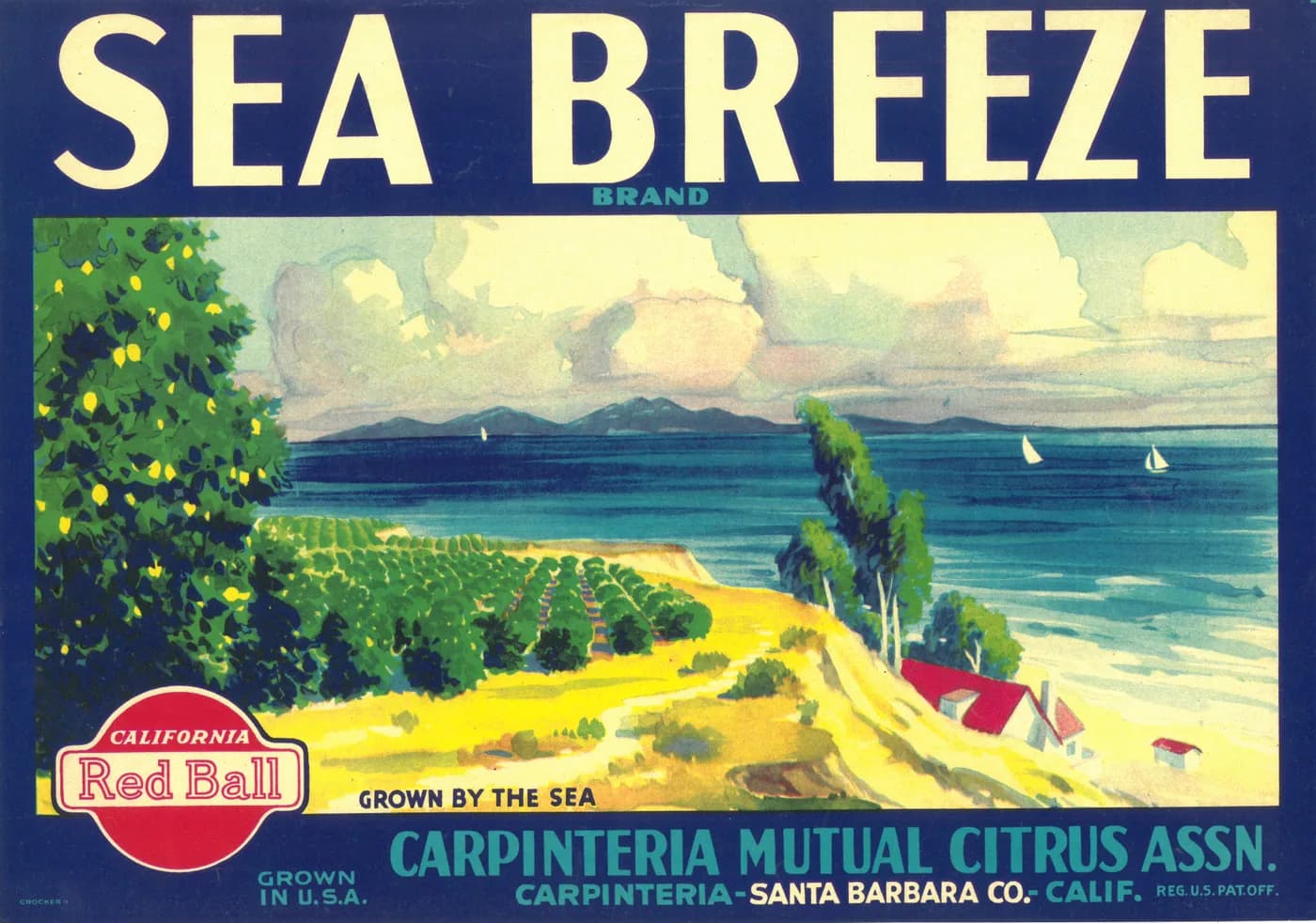
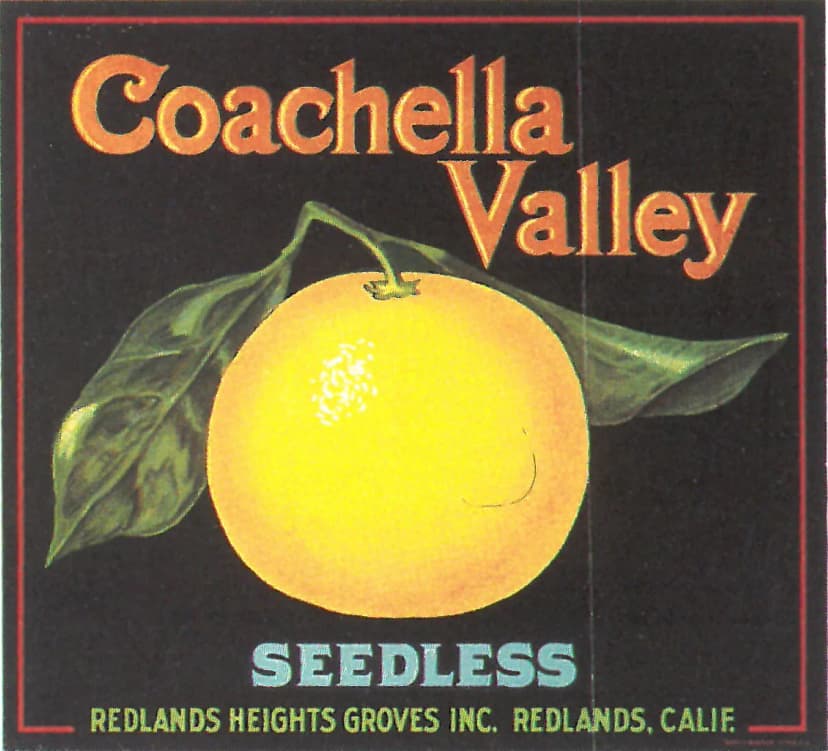
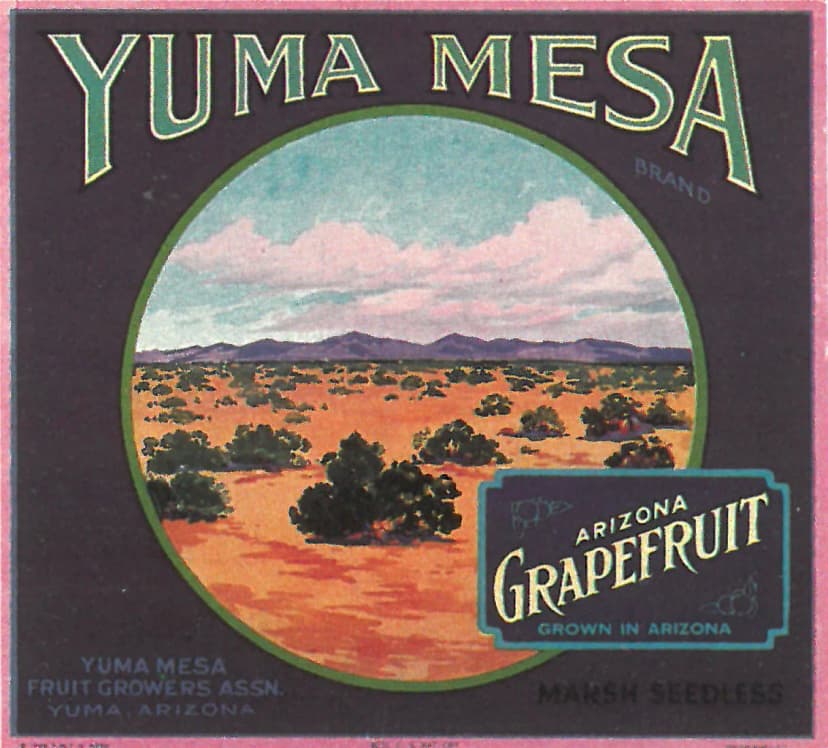
And a newborn citrus industry, more or less by chance, began to discover which regions were climatically suited to certain kinds of citrus. Riverside was ideal for navels. Valencias liked cooler regions most, such as Santa Ana and other parts of Orange County. Areas in Ventura and Santa Barbara counties in the north (fig. 20) and San Diego county in the south produced the best lemons. Though grapefruit trees were not planted in commercial quantities until many years later, they thrived in true desert areas such as California's Coachella Valley (fig. 21) or the area surrounding Yuma near the Arizona-Mexico border (fig. 22). By 1890 enormous plantings of budded navel orange trees began to bear fully, and their fruit was of very fine quality. It became obvious that those who practiced citriculture in California were gaining expertise in leaps and bounds. As propagation improved the various species, higher standards were set and enforced to improve the processing of oranges and lemons. A sequential description of what finally evolved might be helpful here. Citrus fruit was picked by hand in the last century (as it is today), at first only a matter of finding the necessary manpower and ladders. Fortunately an old Civil War veteran in Riverside invented and patented the soft cloth sack with shoulder strap and adjustable open bottom that was soon universally in use. Once the fruit was off the tree, however, growers faced a whole set of new problems: how to pack, ship and identify a perishable product intended for customers who lived several thousand miles away.
Since it was not practical to ship by railway in the fruit baskets or barrels traditionally used in eastern produce markets, a rectangular wooden box was developed that could be easily lifted and efficiently packed in boxcars. The first such crates were labeled by branded or stenciled inscriptions. These marks were soon replaced by citrus crate labels: large, multi-colored lithographs pasted on the crate ends. The grower could choose his label from stock prints to which only his name or that of his company need be added. Or he could have an original picture and logo designed by a professional. He then had his "private" label job-printed in quantity in San Francisco or, later, Los Angeles. The crate was ready, with label intact, but much remained to be done to the fruit before shipment.
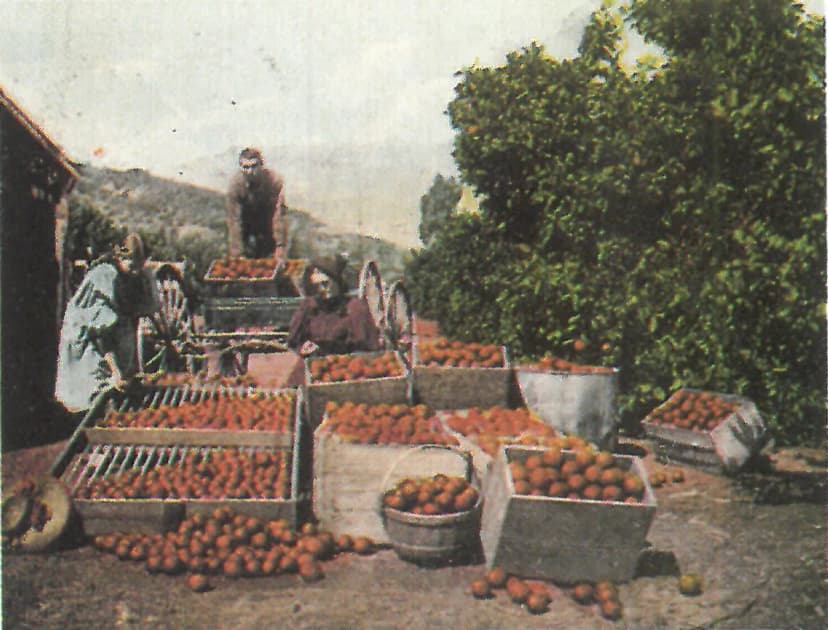
The first packing was done in the groves, with long tables set up between the rows of trees (fig. 23). Oranges or lemons were sometimes wiped off and placed in boxes, sometimes unceremoniously dumped in. After rail shipment began, many packing operations were simply moved to the nearest depot. Freshly-picked fruit was brought in by the wagonload, transferred to crates, and stacked up ready to be loaded. It was soon discovered that to reach a distant destination in decent condition, the fruit required better care. Oranges were easily bruised from finger pressure alone, let alone from being tossed. Any bruise became the site of bacterial invasion which began the decaying process. Soon pickers as well as packers wore gloves at all times, and the supervised packing house became a necessity.
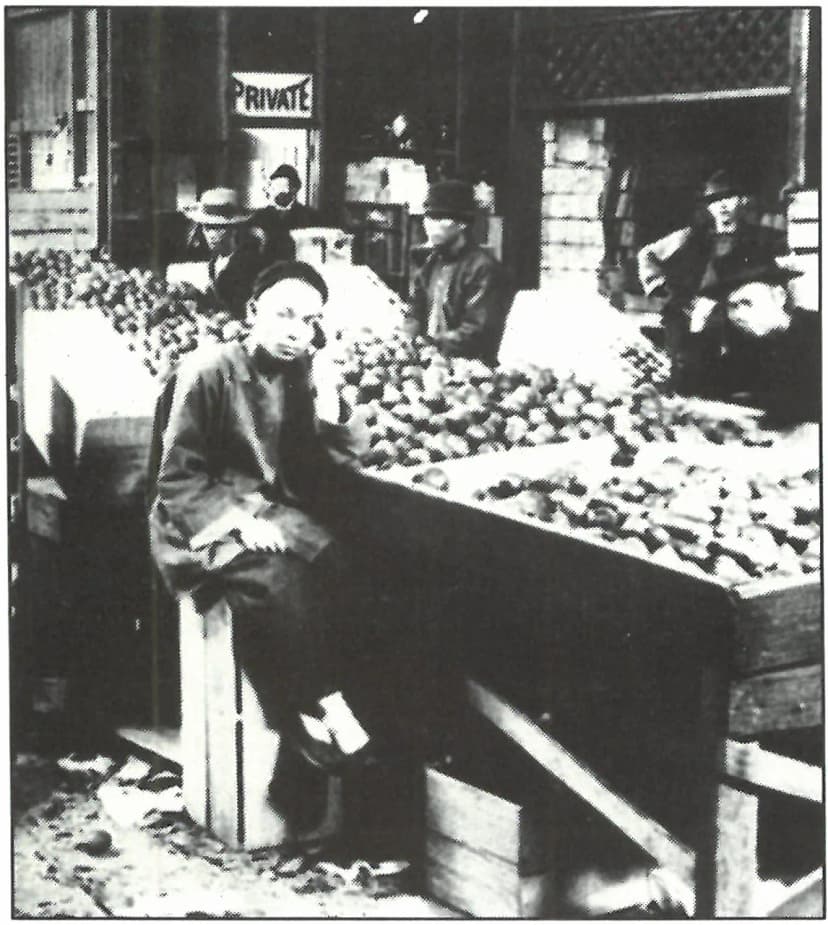
And so actual packing and labeling became only the final step of a fairly elaborate process undertaken after the fruit was picked: first a thorough washing to remove bacteria as well as mud or dust, then a very thin coating of wax applied to each fruit, and finally the fruit was sorted by hand according to quality (fig. 24). Next each fruit, grouped by grade, was passed over the sizer, identical in function to the electric ones used today. The fruit rolled along from one end of the sizer to the other until it dropped into bins (or, in our present age of automation, onto conveyor belts) whenever it reached an opening sufficiently wide to allow its passage (fig. 25). The individual fruits, were uniformly packed with each fruit in any one crate approximately the same size and weight as its fellows. This procedure required too much time, care and equipment for a grower to do it himself. So packing houses were built and individual growers came together into groups to utilize them.
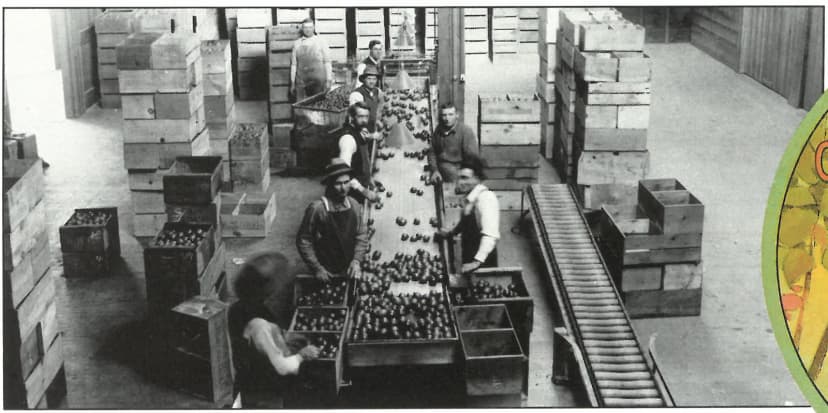
A major problem that soon became apparent had little to do with packing but everything to do with two complicated intangibles: unregulated production and unscrupulous wholesale buyers. Because of the speculative selling practices of the time, farmers often found that a bumper crop of quality oranges still left them with little or no income. Sharp-shooting commission buyers imposed impossible conditions as they purchased oranges still on the tree. Auction or consignment dealers looked out only for their own gain, and the grower often found that the purchase money he expected had evaporated in "dealers expenses." Similarly, if oranges were unwittingly shipped at the same time to the same city, by several growers, the resultant glut on the chosen market meant miserable prices. Such a situation often arose as other eastern cities remained devoid of citrus fruit during the same period. It became apparent that better communications were needed between growers. Only unified group action could improve their marketing situation and their incomes.
By 1890 the boom in orange growing throughout California was reaching a dangerous climax. Fruit was ripening on thousands of trees while millions of potential buyers in the East yearned for it. Yet there was no honest and reliable link between growers and retail grocers, and the 1890s are still called the "red-ink years" in citrus circles. Crops were good but incomes were terrible.
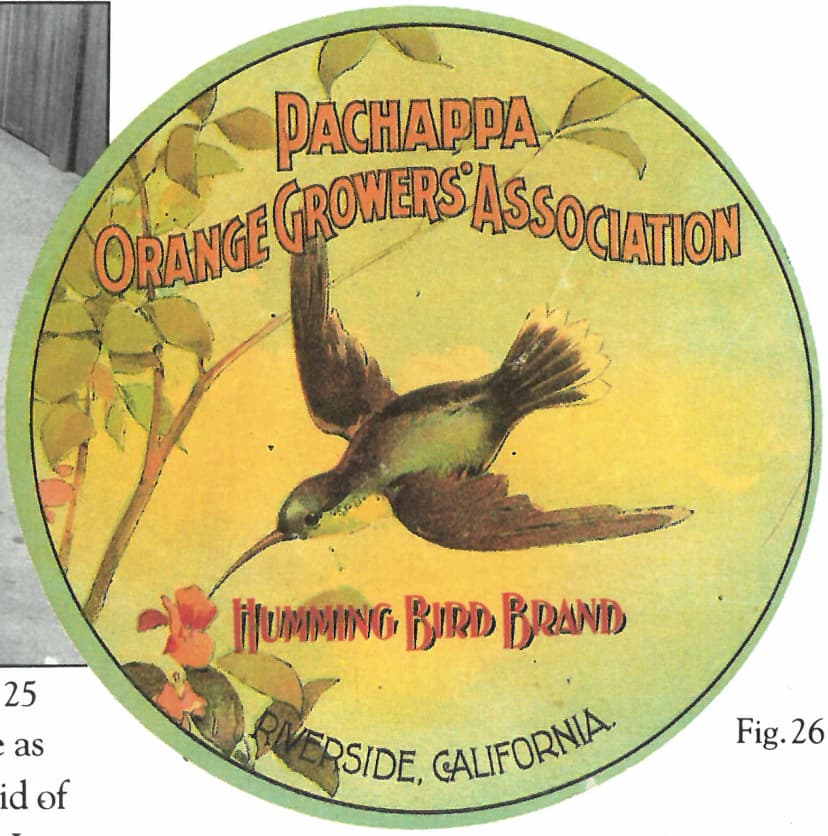 Figure 26
A Riverside grower named T.H.B. Chamblin thought he saw an answer to this problem. With ten neighbors he formed a "pool" called the Pachappa Orange Growers' Association (fig. 26), all designed to process and market all members' oranges cooperatively. The Association contracted with a packing house for grading, packing and shipping. After the fruit was marketed, each grower received his pro rata share of net proceeds according to the grade (i.e., quality) as well as the quantity of fruit he had provided. Thus individual incentive to improve one's product was preserved by the pro rata — invaluable in such a group operation — and the Riverside group as well as a similar one in nearby Claremont made an important discovery: there was strength in numbers.
Chamblin became convinced that marketing conditions for all growers were bound to improve as soon as they showed a united front to the dealers and the railroad men who arbitrarily set shipping rates. He insisted that his group plan the timing of future harvesting and shipping activity with forethought and care. Soon he was assisting in the formation of similar small cooperatives, each in turn to be supervised by a district wide "exchange" which set and enforced quality standards. By 1893 the Pachappa group and others had formed the Riverside Fruit Exchange.
Many anxious growers were meeting throughout California at this time, trying to decide what concerned action might be taken to solve their mutual problems. Chamblin was asked to attend one at the Los Angeles Chamber of Commerce, a meeting which consisted of men from citrus-growing areas as far removed as San Diego in the south or Santa Barbara in the north. The Riversider's explanation of his plan was clear and persuasive. "Let us now have harmony," he said. "Let us forget the localities from which we come. Why is the market demoralized? It is from lack of method and system. The orange industry of Southern California has been left to drift and it is drifting away." As a direct result of the eloquence of this man, the Southern California Fruit Exchange was formed (fig. 27). This was a cooperative composed of seven district exchanges, each of which consisted of a group of "packing associations" such as the Pachappa group. Headquartered at first in the Loring Building in downtown Riverside (fig. 28), the offices were later moved to Los Angeles. As a cooperative, the Exchange proved to be a prototype for many similar ones in other produce industries. Today, a century later, it is still considered a model of its kind.
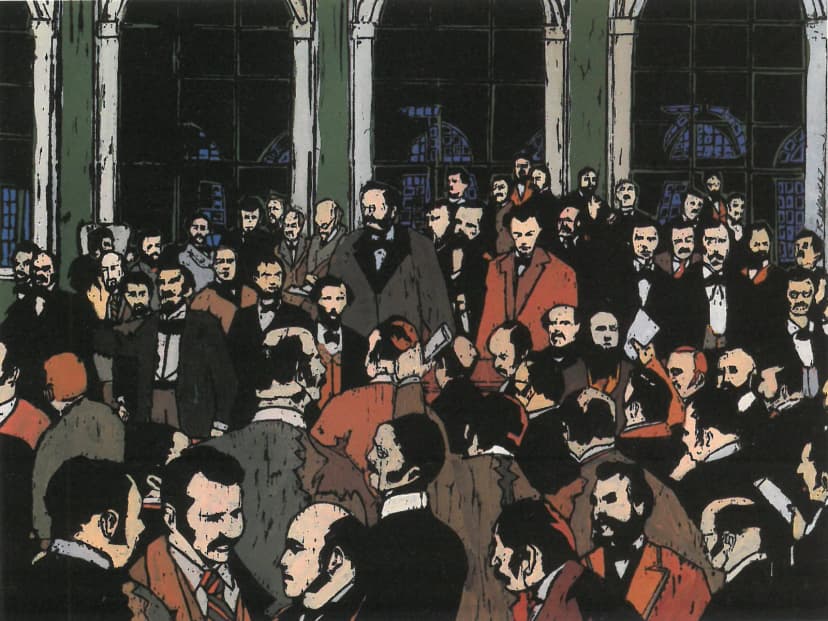
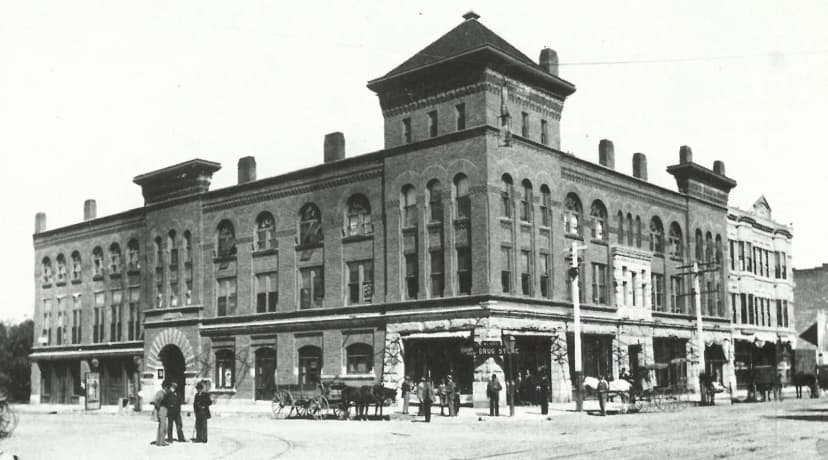
One of the functions of this Exchange was establishing allotment procedures and bringing older marketing operations, such as the cash and consignment systems, into line. Another was group bargaining with the railroads for lower, more uniform freight rates. As the Exchange grew in experience its staff worked to create new markets and expand those which existed. This was an attempt to change the orange from a luxury item to a household necessity, and advertising and other means of promotion were utilized to do exactly that. In 1905 the name of the cooperative was changed to California Fruit Growers Exchange, and a trademark "Sunkist" was developed and registered in 1907. It was used to indicate the highest grade of fruit which Exchange members marketed.
Originally a sort of geometrical sunburst, it was changed to a paper-wrapped navel orange of brilliant gold about 1915. It was soon seen on literally hundreds of different individual labels — those belonging to the grower-members of the Exchange. As a result of the inspectors employed to maintain the fruit quality which the logo signified, this realistic depiction of the Washington navel became one of the world's most widely-recognized trademarks. Indeed, it was so successful that the California Fruit Growers' Exchange dropped that title to assume the famous brand name on the logo. Since 1952 the cooperative which markets some 60% of the oranges, lemons, grapefruit and other citrus grown in California and Arizona has been known simply as "Sunkist Growers." The Sunkist success story, like that of the navel orange itself, actually began in Riverside.
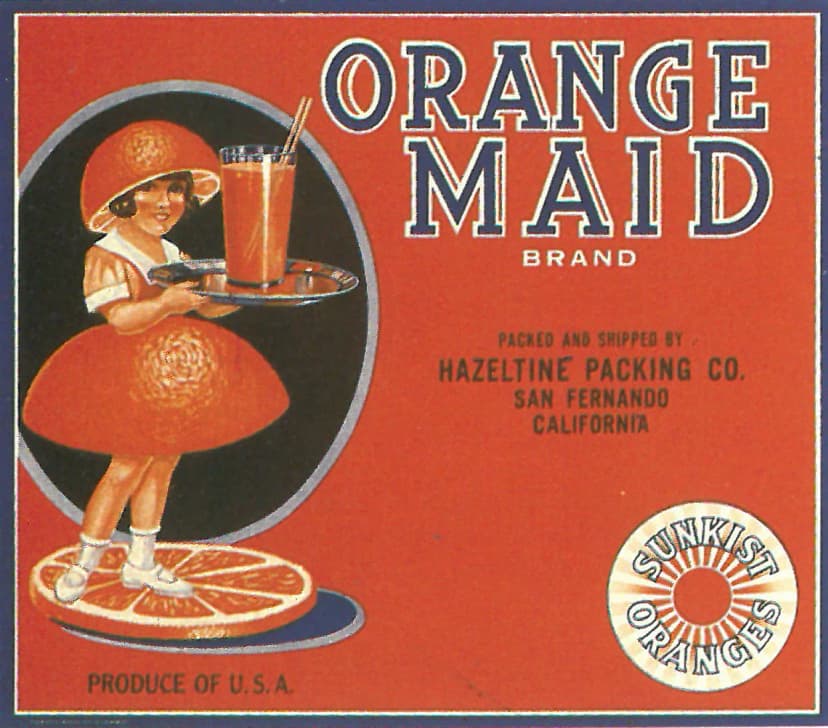 Figure 30
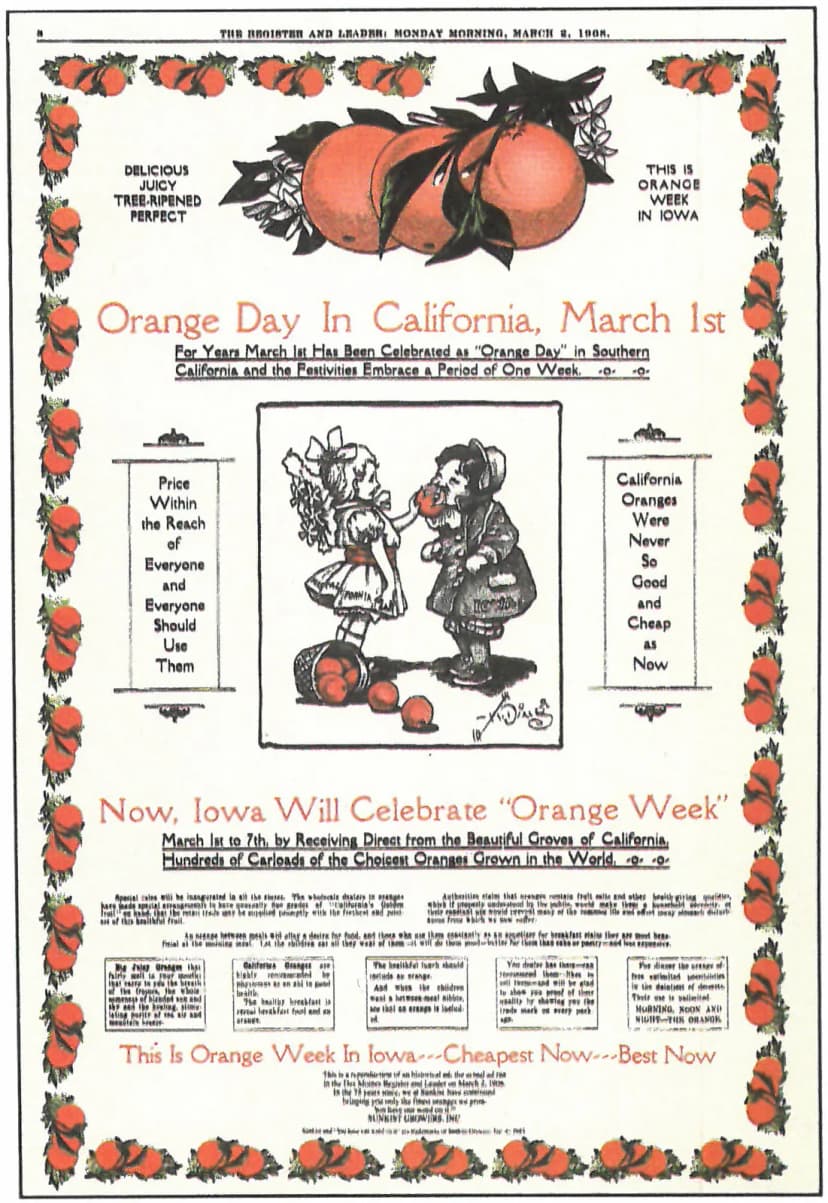
After 1900 the saga of the citrus industry was one of constant promotion and advertisement, ever-watchful striving to improve quality, and a growing affinity of the American public for citrus fruit. Certain milestones stand out, among them the epidemic of citrus fairs and orange festivals that began in Riverside and steeped inland Southern California in bad poetry and beautiful orange blossoms for decades. Or the Iowa Experiment, the world's first citrus advertising campaign, where color layouts in the Des Moines Register and Leader (fig. 29) combined with citrus posters by a railroad to increase orange sales in Iowa by more than 50%; it happened in 1908 and was a red letter event for national advertising, then in its infancy. Though foreign exports did not attain any significance until the 1920s when domestic production exceeded demand, the first American citrus to travel across the ocean was the box of (you guessed it) navel oranges which the Exchange sent to Queen Victoria in London in 1899. As citrus production increased after the turn of the century, growers realized that it would be impossible to market all of their fruit at reasonable prices. It was decided that lower grade citrus should be processed into by-products. The first manufacture of orange products in California was in 1914, and like many subsequent efforts in the same vein, the product was orange marmalade. At about the same time someone realized that it took more than one orange to produce a reasonable amount of juice. "Drink an Orange" became the byword for a new campaign (fig. 30) and the per capita consumption of fresh oranges went from one half orange to two per day. In 1915 vitamins were discovered. By 1920 the Exchange had come out with magazine advertisements stressing "Vitamines", particularly Vitamin C. Indeed, the future looked bright for the citrus industry of the Southwest as well as for the Sunkist trademark.
The Citrus Crate Label
With their bright colors and arresting subject matter, citrus crate labels are as exciting and innovative a manner of advertising as the late 19th-century posters which were the prototypes for many of them. They were designed to do much the same thing: to catch the attention and interest of prospective purchasers.
The early labels, first appearing in the 1880s, were produced by a stone lithography technique which sequentially printed up to six colors each. In the 20th century, lithographs were gradually replaced by photocomposition processes and offset printing. Orange labels were about 11" × 10" (fig. 31), while those used for lemons measured about 8½" × 12" (fig. 32); the variation in size was due to the dimensions of the different-sized crates used for different fruits. These sized crates used for different fruits. These dimensions remained the same for the next 70 years, but the printed images underwent considerable evolution. A survey of the relatively brief history of labels shows that they reflect new styles of art, advertising concepts and design techniques, plus a bewildering maze of thematic strains. Yet their size and product identification remain virtually unchanged.
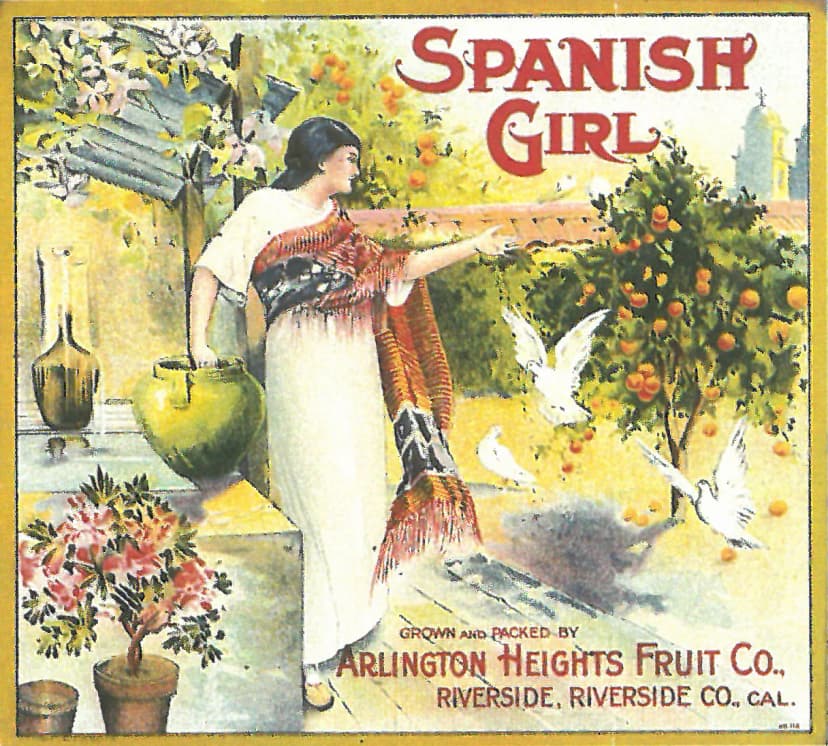
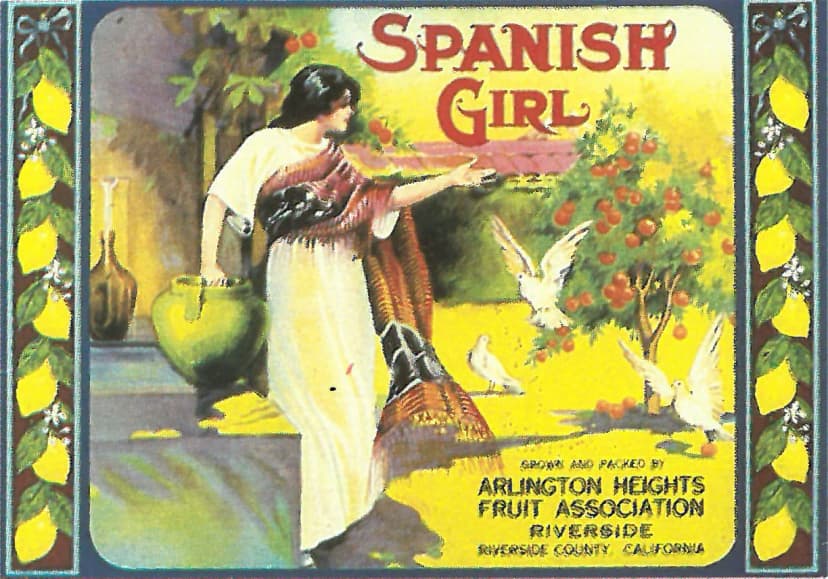
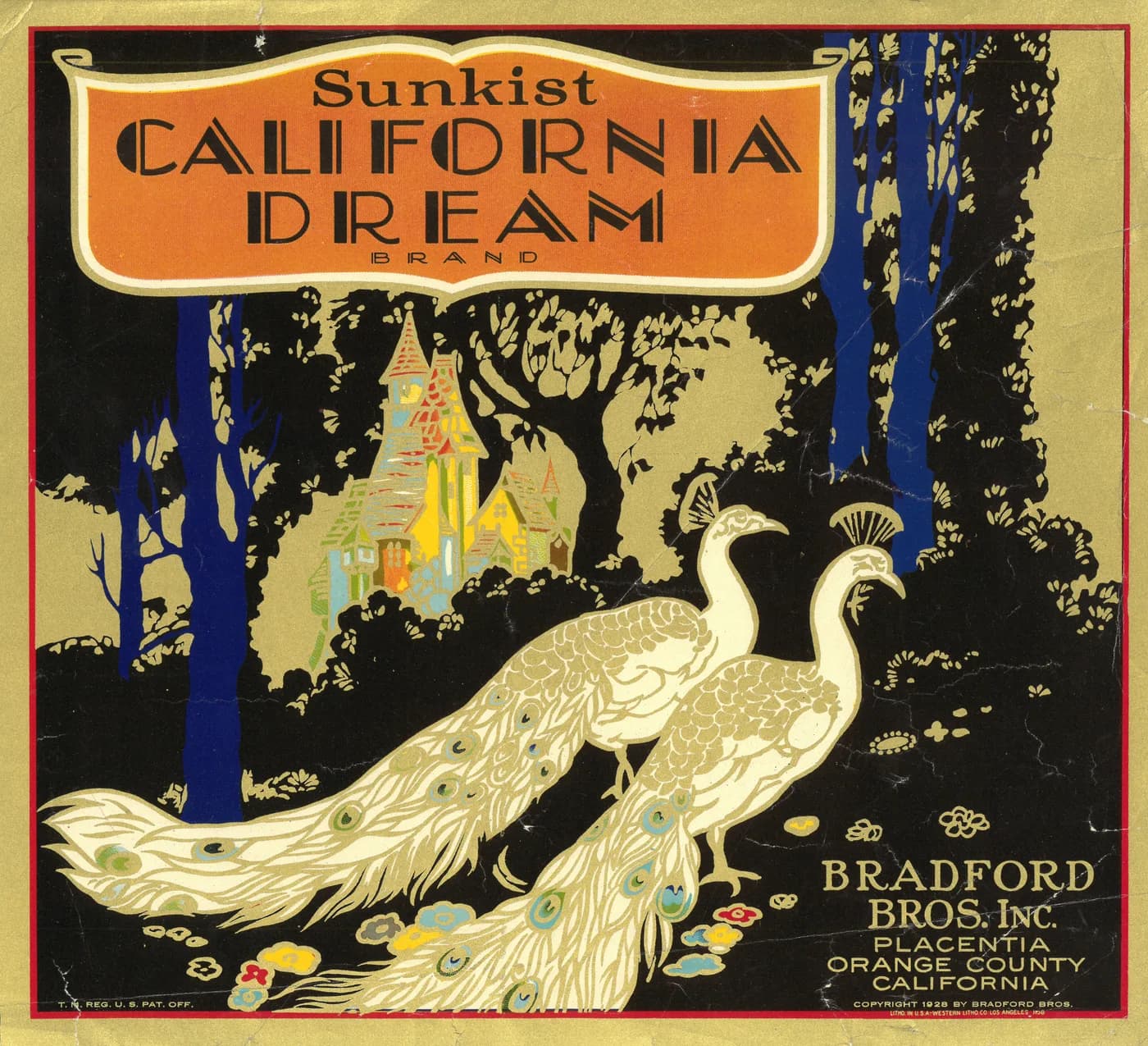
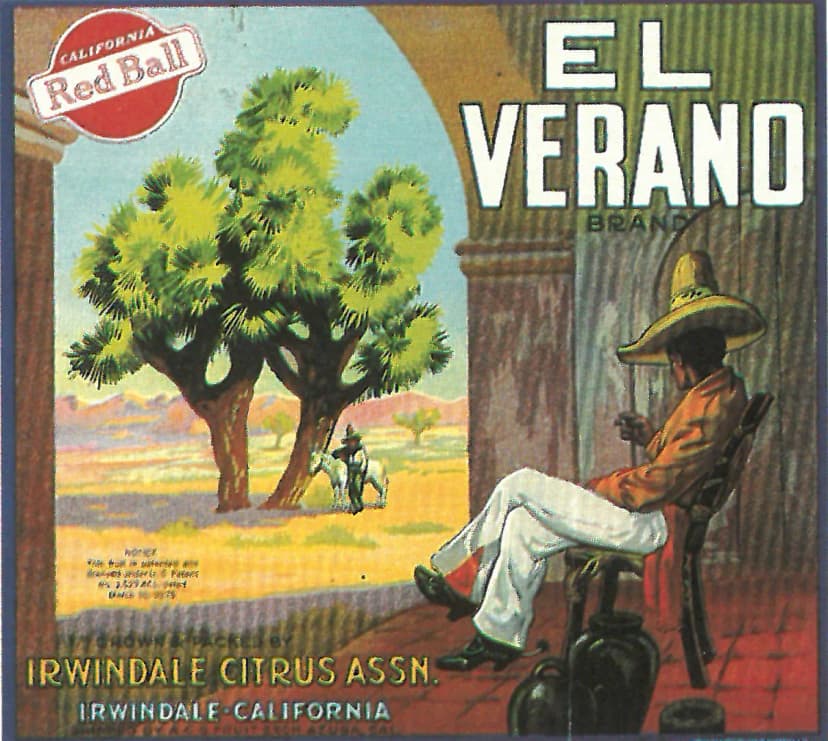
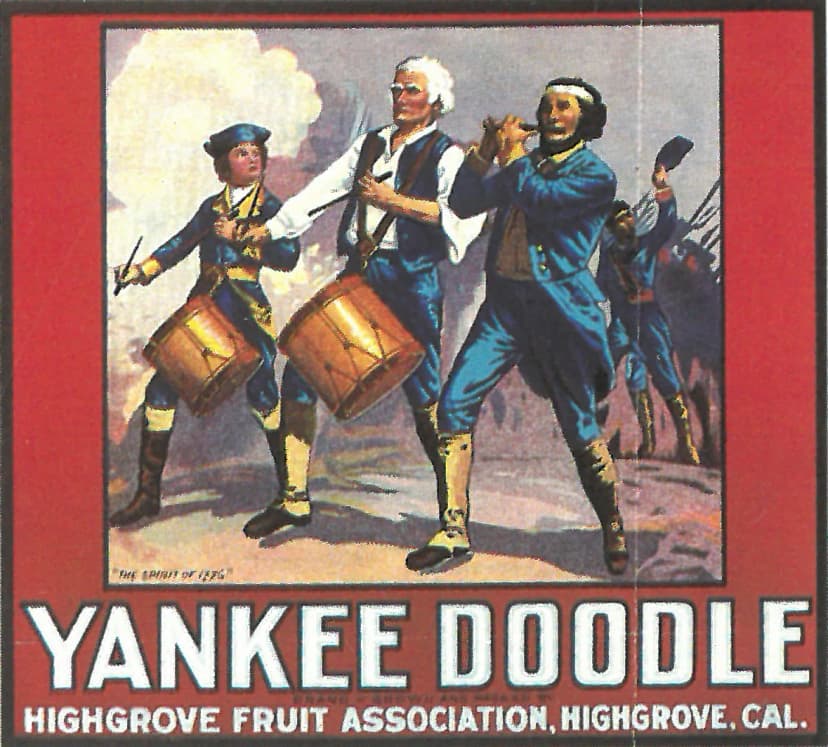
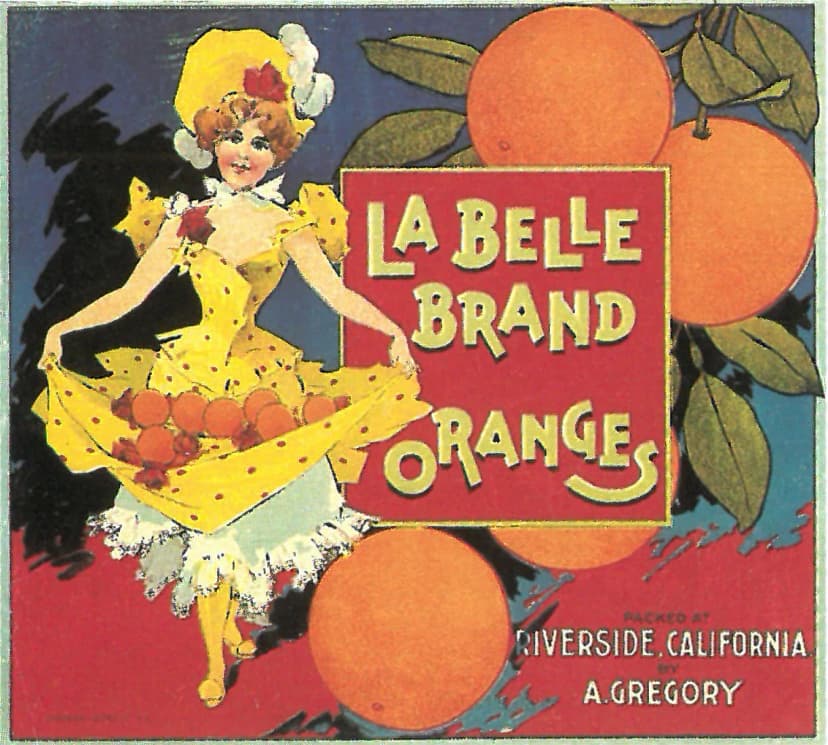
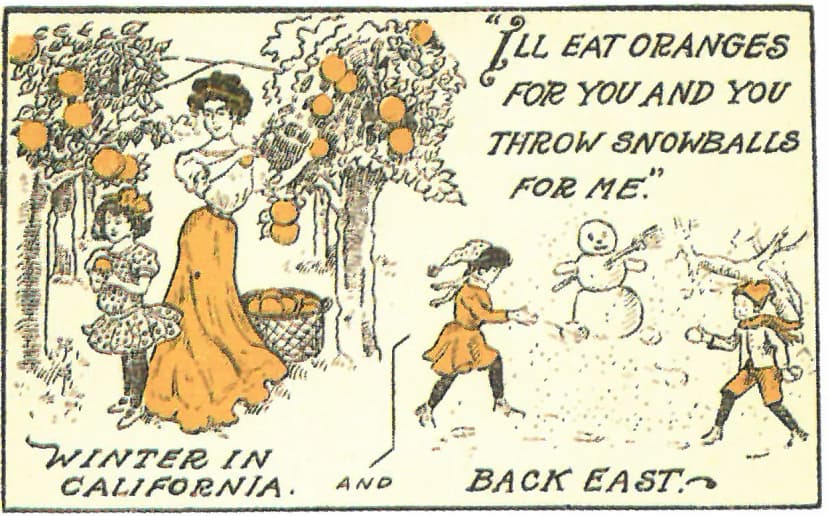
McClelland and Last's definitive work on the subject suggests three distinct periods as a means of classifying the artistic and thematic changes seen on citrus labels. As in all popular art, there is a high coordination between changes in label subjects and simultaneous socio-political changes taking place in America. The first period, extending from about 1885 until 1918, was characterized by label themes illustrated in a naturalistic "real" manner — much like the style of America's best known painters of the time. Label subject matter depended upon the whim of the grower: Southern California scenes, depictions of Mexican days (fig. 33), versions of pioneers in the cowboy-and-Indian west, scenes of Indian life, patriotic themes of Old Glory or incidents in American history (fig. 34); portraits of beautiful women, of birds and animals, or of flowers. There were also a few Art Nouveau designs derived directly from such French posters as those of Jules Cheret (fig. 35). Many labels, whether emphasizing history or a grower's trademark, are alike in their depictions of luscious ripe oranges and views of the California countryside designed to arouse envy in the heart of any blizzard-bound midwesterner (fig. 36). It is no wonder that the population of California increased by more than a third between 1880 and 1890. During the second period, which began shortly after the first World War, Americans became increasingly sophisticated. What had been a predominantly rural society changed into an urban one, and advertising came to the fore, pressing for an increased emphasis on product identification. Orange box labels began to stress the healthful benefits of eating oranges and drinking orange juice (fig. 37). Who would deprive her child of Vitamin C? Surely not the lovely young mothers shows supplying robust toddlers with orange juice. A tall, cooling glass of lemonade (fig. 38) or even a hot toddy might appear on labels intended for lemon crates. It is surprising but true that such American health rituals as breakfast orange juice or therapeutic doses of hot water combined with lemon juice were born of suggestions in the early advertisements (and on the labels) of the citrus industry. But whatever the subject matter, labels of this period usually followed the newly-formed principles of advertising: both message and brand name should be short and simple, distinctive, easily recognized. The label should suggest the contents of the package and, if possible, the source of the fruit. Labels tended more toward clear simple images, forceful titles and direct messages, though the 1920s also became a time of experimentation. Label subject matter ranged from the orange as health object through the omnipresent pretty women or handsome children to less naturalistic depictions of birds and animals in flat colors and simple graphic outline. Fantasy subjects such as storybook characters or tableaux from the world of entertainment were also seen from the 1920s until about 1935.
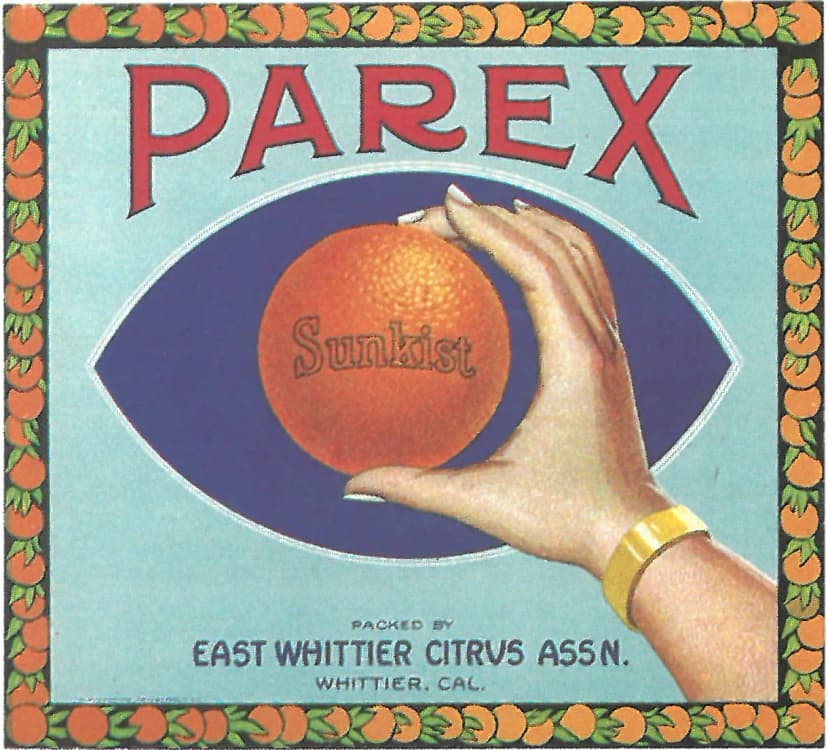
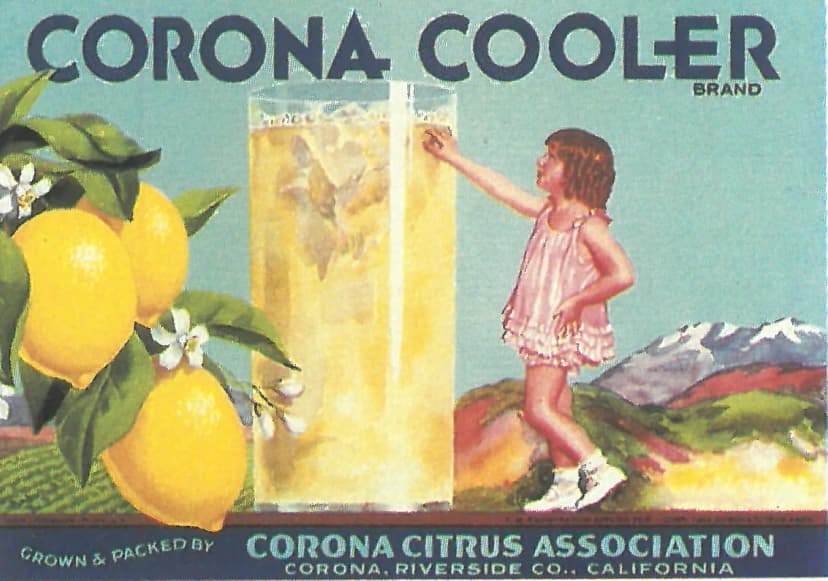
Apparently such labels and other forms of citrus advertisement accomplished their purpose. More than 35 million boxes of oranges alone were shipped from California each year by the mid-30s, and they were packed under some two thousand different brands. Surely this was the zenith of box-end labeling even though there was marked change in the artistic style of labels during this third and final period. Though earlier labels had been created by painters with traditional European art school training, the 1930s saw a new generation of artists take over. They had been trained in American commercial art schools where the emphasis was on product identification and striking design (fig. 39) rather than aesthetic images and sentimental or exotic subject matter. Photographic techniques allowed color gradation effects not possible with lithography, and many older brand logos were simplified and modernized by incorporating standard design elements.
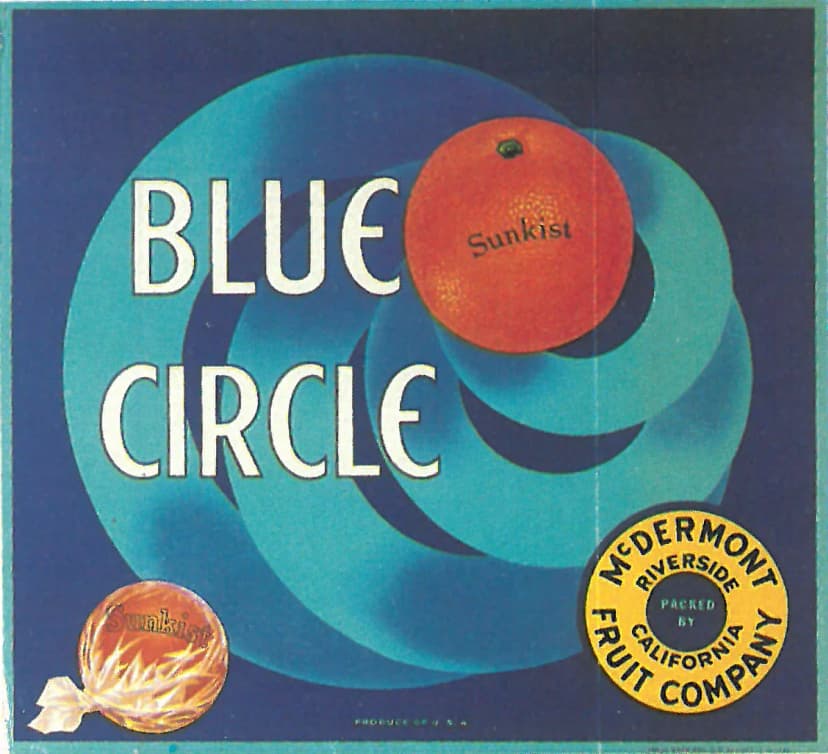 Figure 39
Brand identification was abetted by heightening the visual impact of the letters in curved or sloping arrangements, and by using airbrushed shadows. Massive, dramatic block letters often served as the main image (fig. 40), though at least one orange or lemon was usually in evidence as a bow to tradition. Whether seen singly or in masses, any depiction of fruit was likely to be arranged in abstract geometrical patterns with striking colors deliberately too bright and vibrant to be believed. Subjects other than citrus were liable to be topical — the China Clipper soaring over the Pacific (fig. 41), a popular cartoon character (fig. 42) or, during World War II, battlefield scenes.
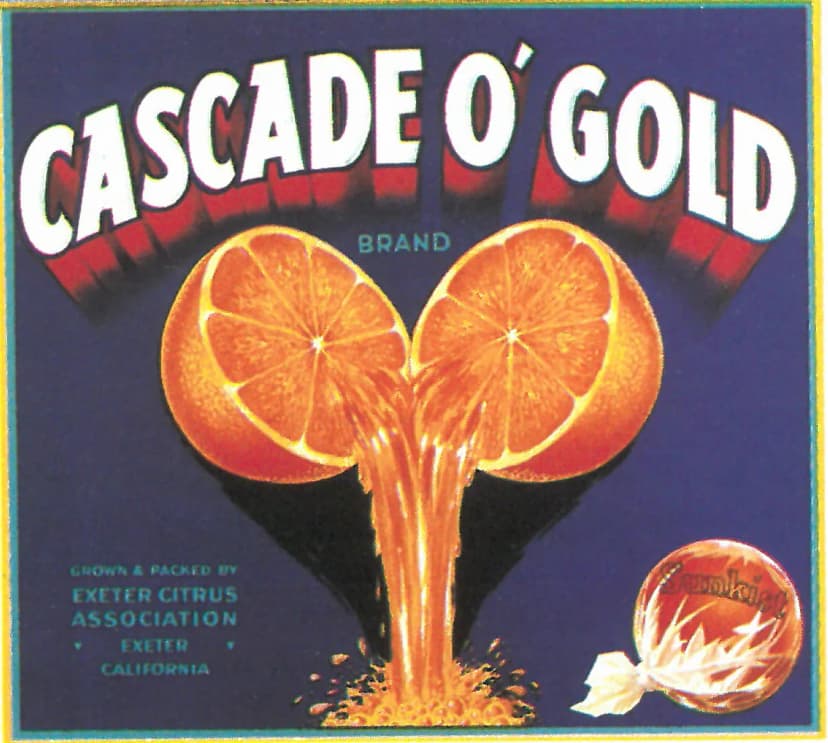
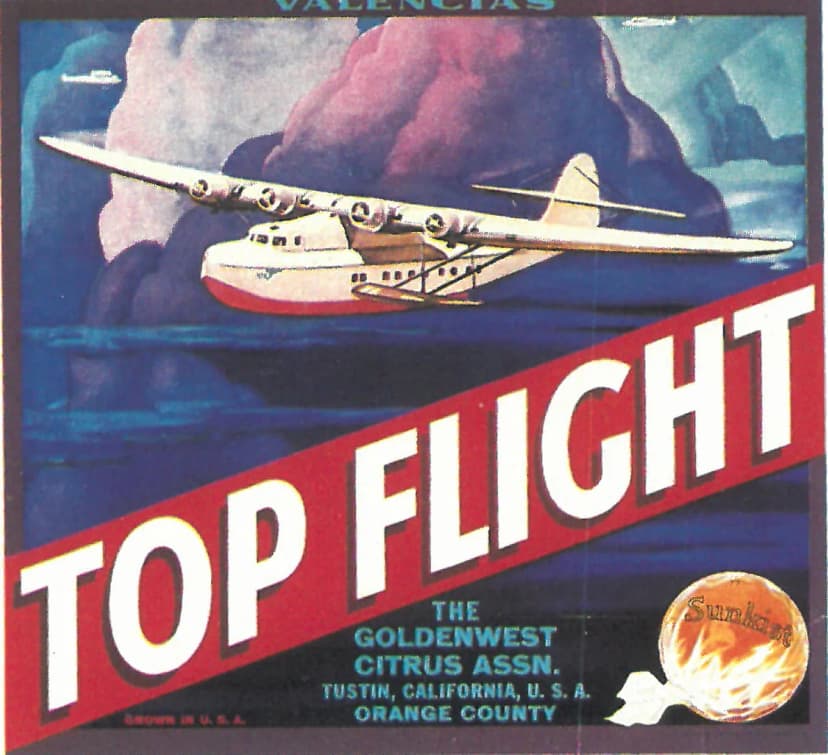
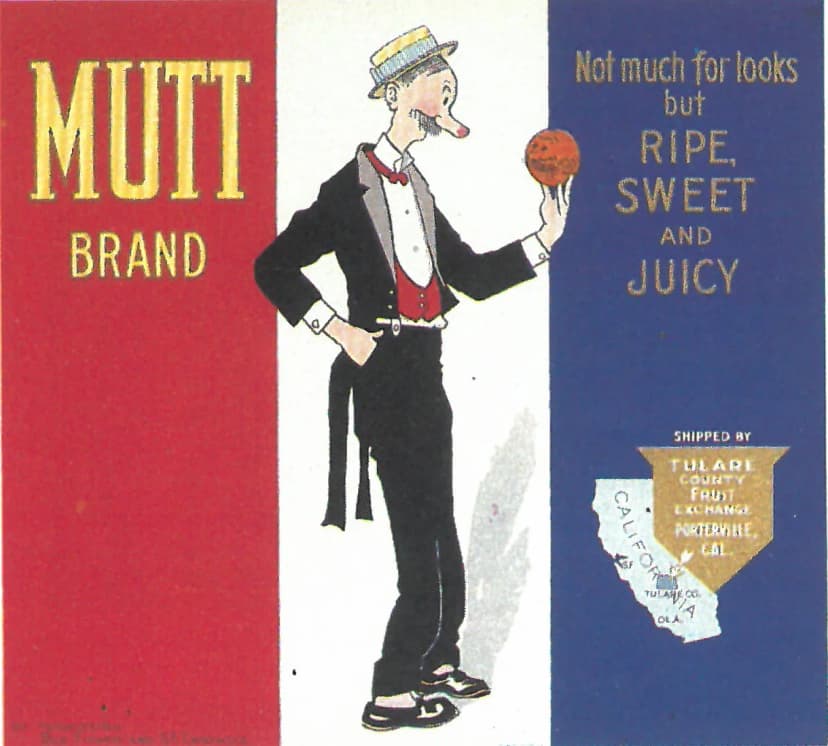

The rations, cutbacks in manpower, and wartime shortage of lumber during the 1940s gave rise to the cardboard packing box, and this meant the demise of the label. Though a few die-hards continued to label their fruit by assembling their own crates or pasting their labels over the printed cardboard (fig. 43), by the early 1950s citrus crate labels, like the crates they had adorned, were a thing of the past. Oranges, lemons and grapefruit were no longer a luxury but a staple of the average American's table. Romantic labels are no longer seen (fig. 44), nor are they needed to promote the fruit that started it all, but they are appreciated today in a manner unthought of during their "working" days, as delightful examples of an imaginative genre of American graphic art. Though they've been retired from duty for nearly 40 years, citrus crate labels are neither gone nor forgotten.